
REG 166 Lien Satisfied / Title Holder Release: Fill Online Free
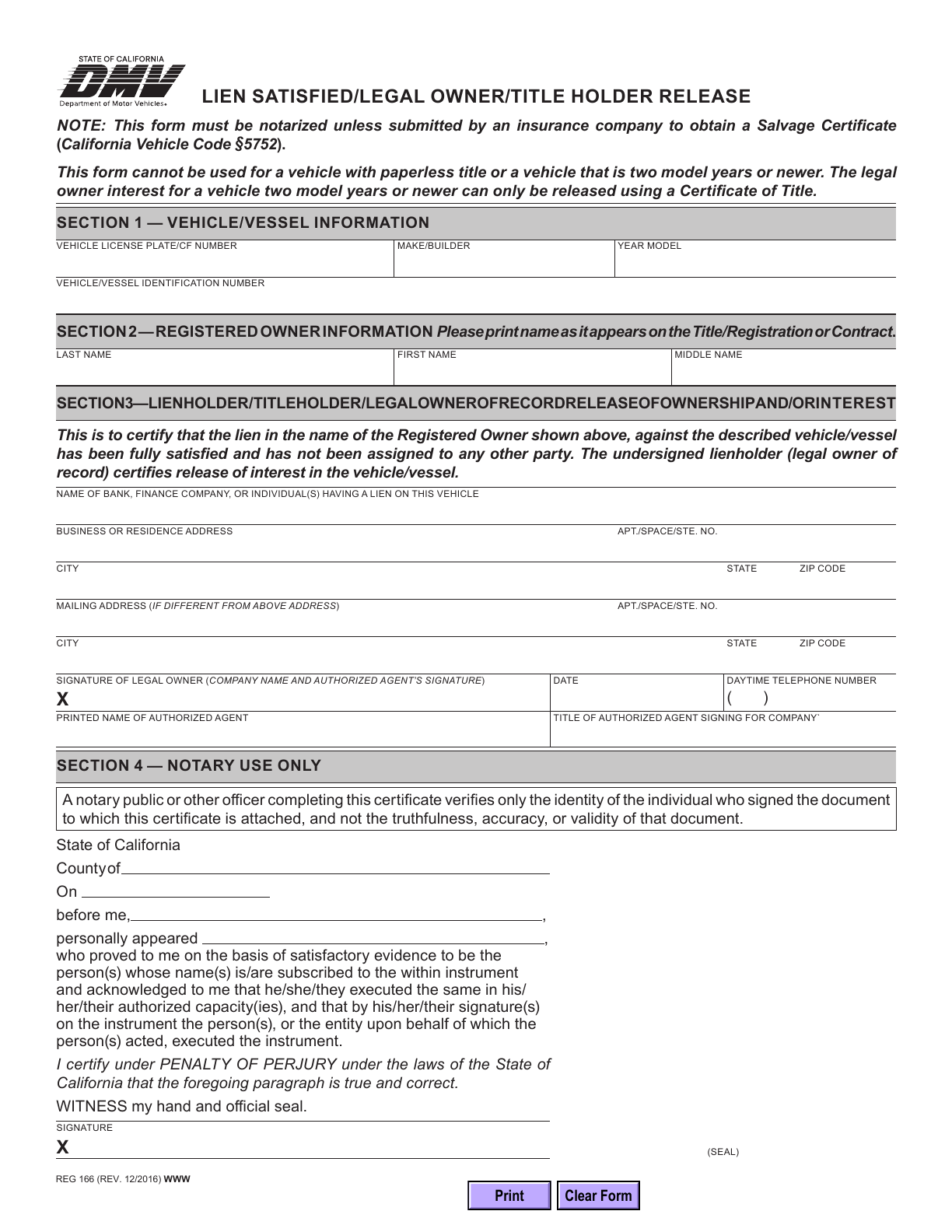
REG 166 records a lienholder’s release of interest in a California vehicle or vessel after the lien has been fully satisfied and not assigned to another party. It separates the registered owner from the legal owner/lienholder.
What is this form?
REG 166 records a lienholder’s release of interest in a California vehicle or vessel after the lien has been fully satisfied and not assigned to another party. It separates the registered owner from the legal owner/lienholder.
Who should use it?
The lienholder or its authorized representative completes the release based on confirmed records. A registered owner can organize the vehicle and owner details but cannot sign as the lender merely because the loan is paid.
When to use a different process
The original excludes paperless-title vehicles and vehicles two model years or newer. For the latter, the legal owner’s interest must be released on the Certificate of Title. Check the title type and model year before using REG 166.
Current form status
- Current edition
- 2016-12-01
- Verified
- 2026-10-11
- Pages
- 1
How to fill REG 166 online
- 1
Confirm the right transaction
The lienholder or its authorized representative completes the release based on confirmed records. A registered owner can organize the vehicle and owner details but cannot sign as the lender merely because the loan is paid.
- 2
Prepare and fill the official PDF
Prepare plate or CF number, VIN/HIN, make/builder, model year, registered owner name exactly as on the title/registration/contract, lienholder name and addresses, and authorized representative contact and title. Confirm satisfaction and no reassignment of the lien.
- 3
Review, sign and submit
Include the reviewed, properly signed and notarized release where DMV requires it for the title transaction. Confirm any other title documents and fees with DMV. Fylune does not release a lien in DMV records.
Prepare the form with Faye
Faye starts with this question: Are you the registered owner, the lienholder, or an authorized representative of the lienholder?
Answer in English, Spanish or Chinese. Faye maps confirmed facts to the editable fields of this English original as you answer. You can skip, correct or undo changes. Review all pages; signatures and any noneditable certification areas require the appropriate person.
Field guidance
Sections 1–2
Sections 1–2: copy vehicle identifiers and registered owner name from the existing records, not the lender’s name.
Section 3
Section 3: all address fields belong to the lienholder/legal owner, including any different mailing address. The agent’s printed name and title do not substitute for signing authority.
Section 4
Section 4: notary-only wording is preserved for the notary; it is not an AI interview section.
Information and documents to prepare
Prepare plate or CF number, VIN/HIN, make/builder, model year, registered owner name exactly as on the title/registration/contract, lienholder name and addresses, and authorized representative contact and title. Confirm satisfaction and no reassignment of the lien.
Signatures and review
The legal owner or authorized company agent signs the release. The form requires notarization except when an insurance company submits it to obtain a Salvage Certificate. The notary completes section 4; Faye fills neither the signature nor notarial certification.
Where to submit the completed form
Include the reviewed, properly signed and notarized release where DMV requires it for the title transaction. Confirm any other title documents and fees with DMV. Fylune does not release a lien in DMV records.
Common mistakes to avoid
Avoid substituting the registered owner for the lienholder, assuming a payoff receipt is a signed release, using the form for an excluded title/year, or filling the notary section yourself.
REG 166 questions
Does REG 166 need notarization?
The form requires it except when an insurance company submits the form to obtain a Salvage Certificate. Do not assume that paying off a loan creates another exception.
Who must sign this form?
The legal owner or authorized company agent signs the release. The form requires notarization except when an insurance company submits it to obtain a Salvage Certificate. The notary completes section 4; Faye fills neither the signature nor notarial certification.
Does Fylune submit this form for me?
Include the reviewed, properly signed and notarized release where DMV requires it for the title transaction. Confirm any other title documents and fees with DMV. Fylune does not release a lien in DMV records.
Form edition and verification history
Official revision: 2016-12. Month-based revision dates use the first day for catalog storage.
Verified the official blank PDF, page count and field mapping.
Independent preparation tool
Fylune is an independent document editor, not the issuing agency. Preparing or downloading a PDF does not sign, certify, file or obtain approval for it. Follow the issuing agency’s current instructions for your transaction.