

A sale price alone is not enough to complete Form 4797. For the 2025 tax year, start with the official IRS form and instructions, build one record packet for each disposed asset, and use the IRS "Where To Make First Entry" table before entering a transaction in Part I, II, III, or IV. The form covers different business-property dispositions and recapture amounts, so a holding period or gain by itself does not settle the classification.
This guide helps you prepare and review the records. It does not determine tax treatment or replace advice from a qualified tax professional.

Confirm the edition before entering anything
The current files reviewed for this guide are the 2025 Form 4797 and the matching 2025 IRS Form 4797 instructions. The form is titled "Sales of Business Property" and also covers certain involuntary conversions and recapture amounts under Sections 179 and 280F(b)(2). It says to attach Form 4797 to your tax return.
Check the year printed on the form against the return you are preparing. Do not use this 2025 field map as a promise that a later edition will keep the same lines or conditions. The IRS directs readers to IRS.gov/Form4797 for later developments.
Build a source packet for each asset
Use records that existed before you opened the PDF. Do not ask an editor or an AI system to reconstruct depreciation, basis, dates, or classification from a short description.
| Record to gather | What to reconcile | Where it appears on the 2025 form |
|---|---|---|
| Asset ledger or fixed-asset register | Property description and asset identity | Part I line 2(a), Part II line 10(a), or Part III line 19(a) |
| Purchase invoice and placed-in-service records | Acquisition date and original cost | Date column for the applicable part; cost or other basis in Part I/II column (f) or Part III line 21 |
| Sale agreement, closing statement, or disposal receipt | Date sold, gross proceeds, and selling expenses | Date sold column; gross sales price in column (d) or Part III line 20; basis and sale-expense record for column (f) or line 21 |
| Improvement and basis-adjustment schedule | Amounts that changed basis, with support for each adjustment | Part I/II column (f) expressly includes improvements and expense of sale; Part III uses cost or other basis plus expense of sale on line 21 |
| Depreciation schedules and prior returns | Depreciation allowed or allowable, Section 179 expense, and other applicable items | Part I/II column (e) or Part III line 22, subject to the detailed line 22 instructions |
| Forms 1099-B or 1099-S, if received | Proceeds included on lines 2, 10, or 20 | Line 1a |
Keep the source document next to the number you plan to enter. A total without its schedule is hard to review, especially when "allowed or allowable" depreciation differs from the amount someone remembers claiming.
Use the IRS first-entry table before choosing a part
The official instructions' first-entry table uses the property type, holding period, and whether the disposition produced a gain or loss. Common equipment examples show why one answer is not enough:
| Established facts | First entry in the 2025 instructions |
|---|---|
| Depreciable tangible trade or business property, held 1 year or less, sold at a gain or loss | Part II |
| Depreciable tangible trade or business property, held more than 1 year, sold at a gain | Part III, Section 1245 |
| Depreciable tangible trade or business property, held more than 1 year, sold at a loss | Part I |
| Depreciable real trade or business property, held more than 1 year, sold at a gain | Part III, Section 1250 |
| Real or tangible business property deducted under the de minimis safe harbor | Part II, whether held 1 year or less or more than 1 year |
Treat the table as the first check. Mixed-use property, installment sales, like-kind exchanges, involuntary conversions, partial MACRS dispositions, partnership or S corporation items, and property not used in a trade or business can trigger other instructions or forms. Mark those facts as unresolved instead of forcing them into the simple equipment path.
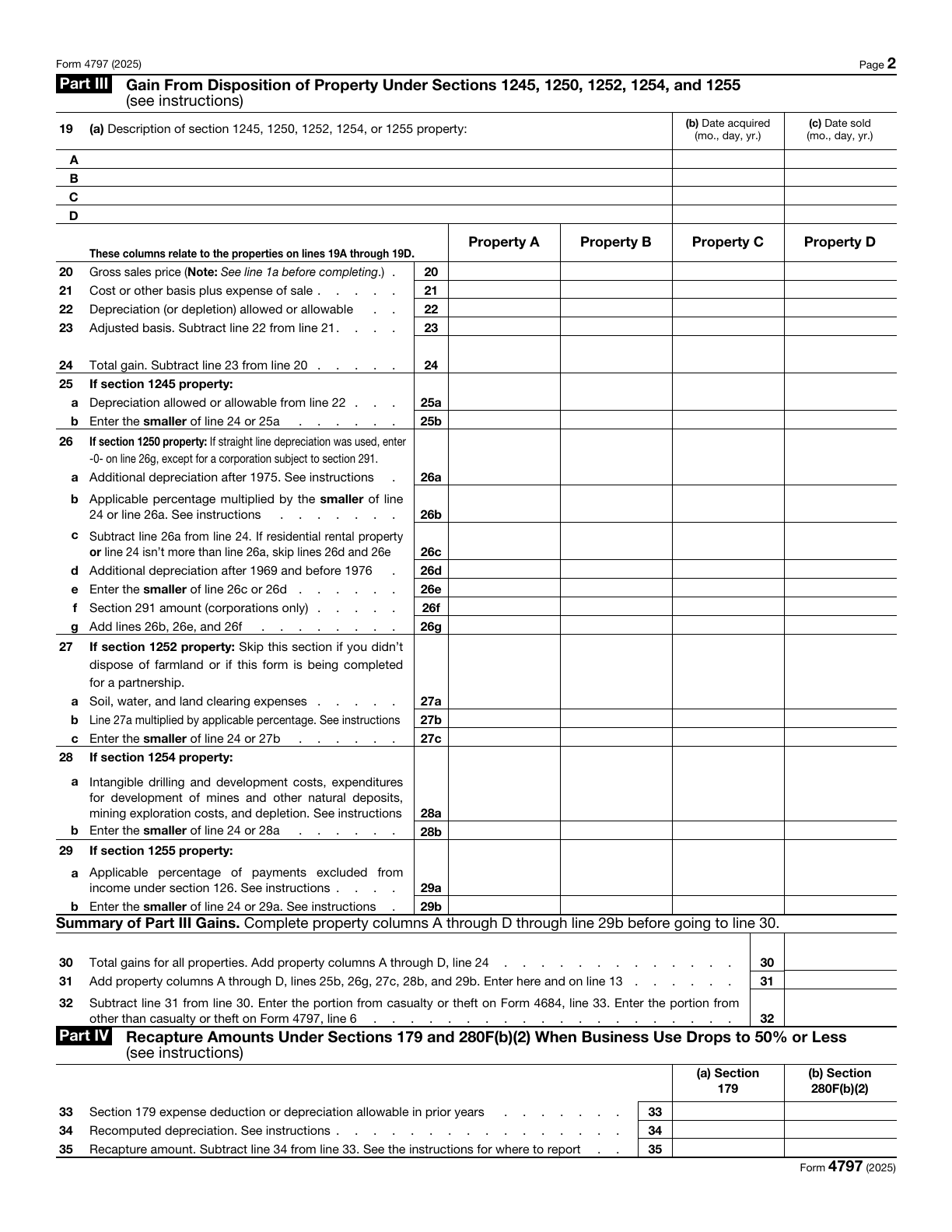
Official 2025 Form 4797, page 2. Part III contains the property columns and recapture calculations; Part IV applies only to the business-use decrease rules stated on the form and in the instructions.
A fictional record-to-field example
The numbers below are fictional. They show how established records connect to the 2025 form, not how any taxpayer should classify a real asset.
Assume a preparer has confirmed all of the following: the asset is Section 1245 business equipment, it was held more than 1 year, the sale was not an installment sale, and no exception changes the Part III treatment.
| Fictional source fact | Amount or date | 2025 Form 4797 entry |
|---|---|---|
| Equipment description | Commercial mixer, asset EQ-104 | Line 19(a), Property A |
| Acquisition date | 03/15/2022 | Line 19(b), Property A |
| Sale date | 08/20/2025 | Line 19(c), Property A |
| Gross sales price | $18,000 | Line 20 |
| Recorded cost or other basis plus expense of sale | $30,500 | Line 21 |
| Depreciation allowed or allowable from the established schedule | $18,000 | Line 22 and line 25a |
| Adjusted basis: 18,000 | $12,500 | Line 23 |
| Total gain: 12,500 | $5,500 | Line 24 |
| Smaller of line 24 or line 25a | $5,500 | Line 25b |
The arithmetic follows the labels on page 2 of the official form. The example does not establish that a reader's equipment is Section 1245 property, that 18,000 is the correct depreciation figure. Those inputs must come from the taxpayer's records and the applicable IRS rules.
Review Part III and Part IV only when they apply
Part III is not a general worksheet for every sale. The IRS Form 4797 instructions say it is used to figure depreciation and other recapture that must be reported as ordinary income for certain property. For property held 1 year or less, the instructions generally direct the taxpayer to Part II instead, subject to the exceptions in the first-entry table.
For a Part III transaction, check these items before accepting the calculation:
- Lines 19 through 22 match the asset record, sale record, and depreciation schedule.
- Line 23 subtracts line 22 from line 21.
- Line 24 subtracts line 23 from line 20.
- The property category on lines 25 through 29 is supported. Do not assume all depreciable property belongs on line 25.
- If more than four properties need Part III, the instructions call for additional Forms 4797.
- If the sale used the installment method, check the Form 6252 instructions before completing Part III.
Part IV addresses a different event. Column (a) applies when business use of qualifying Section 179 property decreases to 50% or less during the year. Column (b) addresses listed property placed in service in an earlier year when business use decreases to 50% or less. If more than one property is subject to those recapture rules, the IRS says to calculate each property separately and attach a statement. Do not complete Part IV just because an asset was sold.
Questions to resolve before the return handoff
Take unresolved items to the preparer with the supporting document attached. Useful questions include:
- Was the asset used in a trade or business, held for investment, or used partly for personal purposes?
- Has the property category for the first-entry table and any Section 1245, 1250, 1252, 1254, or 1255 treatment been confirmed?
- Does the depreciation figure include all allowed or allowable depreciation, the Section 179 deduction, and any special depreciation allowance that belongs on line 22?
- Did an installment sale, like-kind exchange, casualty, involuntary conversion, partial MACRS disposition, or partnership/S corporation allocation occur?
- For a Part I gain, are there nonrecaptured net Section 1231 losses from the five preceding tax years that affect lines 8 and 9?
- Did business use of Section 179 or listed property fall to 50% or less, making Part IV relevant?
Record every unresolved item in the packet and leave the related field unanswered until the preparer resolves it.
How to fill out Form 4797 without guessing at missing facts
- Download the official 2025 Form 4797 PDF and keep the matching IRS instructions open.
- Confirm the printed tax year and build the asset packet before entering values.
- Use the first-entry table to identify the part that needs review. If a condition is uncertain, flag it for the preparer.
- Enter only facts supported by the packet. Leave unresolved fields and classifications unanswered.
- Reconcile the form against the source records, related schedules, and the return to which Form 4797 will be attached.
- Save a reviewed copy with the supporting schedules for the tax-return handoff.
Fylune does not have a verified built-in Form 4797 template for this workflow. Use the manual path instead: Download the official PDF, then choose the file in Fylune to prepare and review your copy. The Fylune browser editor lets you choose a PDF from your device and saves Web edits as account-owned cloud snapshots. Fylune does not file the form with the IRS. Free PDF exports include a watermark, while paid options provide clean exports.
Final PDF review checklist
- The form and instructions both say 2025 for this worked example.
- The name and identifying number match the tax return.
- Each property description, acquisition date, and sale date traces to a record.
- Gross proceeds reconcile to the sale record and any applicable Form 1099-B or 1099-S amount entered on line 1a.
- Cost or other basis, improvements, selling expenses, and depreciation reconcile to retained schedules.
- The selected part agrees with the IRS first-entry table and all known conditions.
- Part III uses the correct property category, and Part IV is present only when its business-use decrease rule applies.
- Related forms and statements are included when the instructions require them.
- No missing fact was replaced with an estimate or an AI-generated value.
- The reviewed PDF and its source packet are retained with the return records.
Form 4797 itself says to attach it to the tax return. Follow the filing and signature instructions for the complete return and the taxpayer's filing method. Downloading a PDF from Fylune does not submit it.
Questions about preparing the 2025 form
Which Form 4797 edition does this guide cover?
It covers the 2025 form and 2025 instructions retrieved from the IRS. Check IRS.gov/Form4797 for later developments and use the edition that matches the return you are preparing.
How do I know whether to start in Part I, II, or III?
Use the IRS "Where To Make First Entry" table. It considers the type of property, the holding period, and whether the transaction produced a gain or loss. Special situations can change the path.
When should I review Part IV?
Review Part IV when business use of applicable Section 179 or listed property decreases to 50% or less. The 2025 instructions describe separate columns and calculations for those cases.
Can I submit Form 4797 through Fylune?
No. Fylune can open the official PDF so you can prepare, review, and download a copy. The IRS form says to attach Form 4797 to the tax return; Fylune does not file it with the agency.
For more source-backed document walkthroughs, browse the Fylune government-form guides.
Sources
- 2025 Form 4797, Sales of Business Property, Internal Revenue Service
- 2025 Instructions for Form 4797, Internal Revenue Service
- Fylune browser editor
- Fylune Blog