

Form 8283 reports information about noncash charitable contributions. It does not calculate whether a deduction is allowed or how much you may deduct. For a contribution covered by these form 8283 instructions, start with the official Form 8283, Rev. December 2025 and the matching IRS instructions. Then map your records to Section A or Section B before you type into the PDF.
Before you enter anything, work through six checks:
- Confirm that Rev. December 2025 is the edition you need for the return you are preparing.
- List each donee and each item or group of similar items.
- Record dates, acquisition details, basis, claimed value, and valuation support before choosing a section.
- Check whether the property type creates an exception to the usual dollar split.
- Obtain any qualified appraisal, appraiser declaration, or donee acknowledgment that the current instructions require.
- Review both pages of the completed PDF and follow your tax return's filing instructions.
This guide explains the record-to-form handoff. It is not tax advice, an appraisal, or a filing service.

What Form 8283 reports
The IRS says to use Form 8283 to report information about noncash charitable contributions. The form itself says to attach one or more copies to your tax return if you claimed a total deduction of over $500 for all contributed property. The instructions add detail for individual contributions and groups of similar items, including special rules for business entities and pass-through entities. Check the current Form 8283 instructions for your situation.
Do not use this form to report volunteer out-of-pocket expenses or amounts given by check or credit card. The IRS treats those as cash contributions. Form 8283 also does not determine the deduction amount; the form tells you to figure that amount before completing it. File it with the return for the year you contribute the property and first claim a deduction, and check the carryover instructions if an unused deduction moves to a later year.
The edition matters. This article and its fictional example use Form 8283 (Rev. December 2025). The IRS posts future developments at IRS.gov/Form8283, so recheck the revision before filing.
Build a donation ledger before opening the PDF
Receipts, purchase records, and valuation evidence answer different questions. A donee receipt may establish when and what the organization received, but it does not necessarily establish your acquisition date, basis, claimed amount, or valuation method.
Create one row for each item or supportable group and keep the source beside the value:
| Ledger field | What to record | Likely source | What still needs review |
|---|---|---|---|
| Donee | Organization name and address | Receipt or acknowledgment | Confirm the organization and filing treatment under the applicable rules |
| Property | Specific description and condition | Photos, inventory, receipt | Use enough detail for the property's value and type |
| Contribution date | Date the property was contributed | Donee receipt | Keep separate rows if contributions occurred on different dates |
| Acquisition date | Approximate month and year acquired | Purchase record or ownership file | "Various" is allowed only in the circumstances stated in the instructions |
| How acquired | Purchase, gift, inheritance, exchange, or another supported method | Ownership records | Do not infer a method from the item's current location |
| Cost or adjusted basis | Your documented basis | Invoice, prior return, or basis schedule | This is not automatically the same as fair market value |
| Claimed amount or value | Amount used for the return and form | Return workpapers and valuation evidence | Reductions and special property rules may change the reported amount |
| Valuation method | Method used to determine value | Appraisal, comparable sales, catalog, or other support | Section B generally requires a qualified written appraisal |
The IRS defines similar items as property in the same general category or type, such as books, clothing, jewelry, paintings, coin collections, land, or buildings. Add the claimed deductions for the group when testing the $5,000 Section A or Section B split, even when items went to more than one donee. If Section B applies, the IRS requires a separate Section B form for each donee organization.
Choose Section A or Section B by amount and property type
A universal "5,000 equals B" shortcut is incomplete. The current instructions use both the claimed deduction and the type of property.
| Question | Section A | Section B |
|---|---|---|
| Claimed deduction for an item or group of similar items | More than 5,000 | More than $5,000 |
| Publicly traded securities | Section A, even above $5,000 | Not reported here when they meet the Section A definition |
| Certain vehicles, intellectual property, and inventory | May remain in Section A under the listed exceptions | Check the specific rule before selecting Section B |
| Clothing or household item not in good used condition or better | Check the special rule | Section B is required for a single such item with a claimed deduction over $500 |
| Appraisal | Depends on the property and other rules | A written qualified appraisal is generally required |
Read the full Form 8283 instructions before choosing. Publicly traded securities and other listed property can stay in Section A even when the claimed amount exceeds 5,000, even if no single item does.
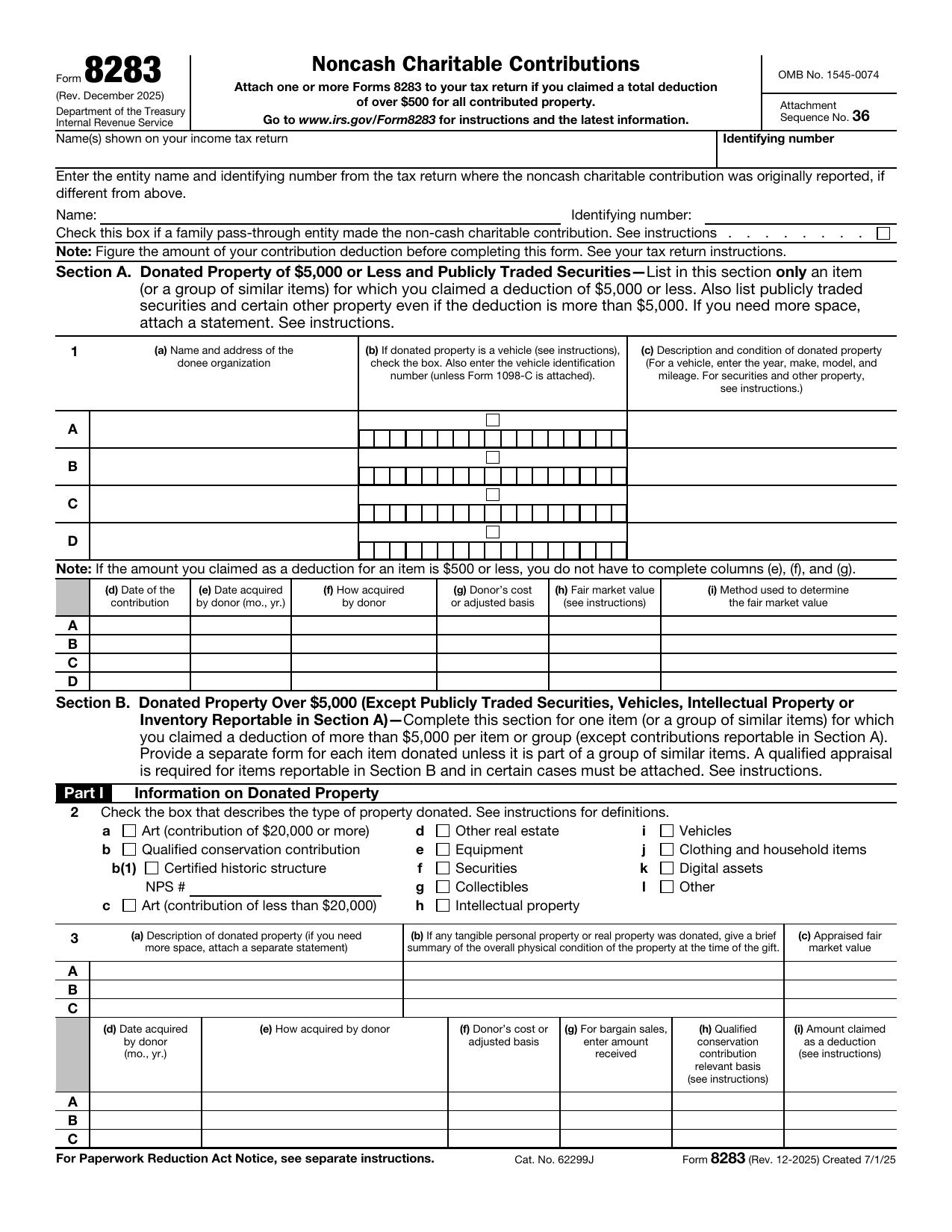
Official Form 8283, Rev. December 2025, page 1. Use the IRS PDF as the source document.
A fictional Section A record-to-column example
The example below is fictional. It illustrates field mapping only and does not establish that the donee is qualified, that the claimed amount is deductible, or that the valuation method is sufficient for a real contribution.
Assume a donor has records for one used dining table:
| Source record | Fictional fact |
|---|---|
| Donee receipt | Example Community Charity, 100 Sample Street, Exampletown, NY 10000 |
| Donee receipt | Contribution date: October 15, 2025 |
| Donor purchase record | Acquired by purchase in May 2020 |
| Donor purchase record | Cost: $1,200 |
| Condition notes and photos | Used dining table, solid wood, good used condition, light surface wear |
| Valuation workpaper | Claimed value: $800; method: comparable sales |
Map those records to Section A, line 1:
| Form field | Fictional entry | Review point |
|---|---|---|
| (a) Donee | Example Community Charity and its fictional address | Confirm the real organization's name and address from your record |
| (b) Vehicle | Leave the vehicle box unchecked | This fictional property is not a vehicle |
| (c) Description and condition | Used solid-wood dining table; good used condition; light surface wear | A receipt may name the item, while photos and inventory notes support condition |
| (d) Contribution date | 10/15/2025 | Use the supported date of contribution |
| (e) Date acquired | 05/2020 | Keep acquisition date separate from donation date |
| (f) How acquired | Purchase | Use the actual acquisition method |
| (g) Cost or adjusted basis | $1,200 | Confirm basis from records; do not copy the claimed value here |
| (h) Fair market value or reduced contribution amount | $800 | The instructions require a reduced amount here when a reduction applies |
| (i) Valuation method | Comparable sales | Keep the comparison evidence with the workpapers |
The IRS instructions permit entries such as "Appraisal," "Thrift shop value," "Catalog," or "Comparable sales" for column (i), depending on the property. Naming a method does not prove the resulting amount. Keep the underlying evidence, and obtain professional advice when the valuation or deduction treatment is uncertain.
Section B has separate donor, appraiser, and donee jobs
Section B is an appraisal summary, not the appraisal itself. The IRS instructions say that items reportable in Section B require a written qualified appraisal by a qualified appraiser. They also say that an appraisal is generally kept with your records rather than attached, but list cases where it must accompany the return, including specified art, certain clothing or household items, easements on certified historic structures, and deductions over $500,000. Review the current instructions for the property in question rather than assuming one attachment rule covers every contribution.
The handoff works like this:
- The donor records the property facts and completes the applicable donor fields.
- A qualified appraiser prepares the separate appraisal and completes Part IV when required. The IRS instructions define who can qualify and require the appraiser's identifying number in Part IV.
- The donee organization completes and signs Part V for property described in Section B, Part I. Before sending the form to the donee, the donor must complete at least the donor name, identifying number, and property description. Real or tangible personal property also needs its physical condition described.
- The donee returns the form to the donor. The donor gives the donee a copy of Section B and finishes any remaining applicable information.
Do not type an appraiser's declaration or a donee acknowledgment on that person's behalf. Fylune cannot produce a qualified appraisal, decide whether an appraiser meets the IRS definition, or value donated property.
Check attachments and signatures before export
The current instructions require filers to complete the requested lines rather than writing that information is "available upon request." If a required number cannot be entered for reasonable cause, the instructions describe using an explanatory attachment instead of leaving a nonresponsive entry.
Use this review list against the official instructions for form 8283:
- Confirm the form and instructions both say Rev. December 2025.
- Recheck Section A or Section B against property type and the claimed deduction for the item or group.
- Verify that every row uses the correct donee and contribution date.
- Compare acquisition date, acquisition method, basis, and claimed amount with their separate source records.
- Check every continuation statement that was needed because a line lacked space.
- For Section B, confirm whether a qualified appraisal is required and whether the instructions require it to be attached for this property.
- Confirm that the appraiser and donee completed their own required declarations or acknowledgments.
- Inspect page 2 for Part II conditions, Part III donor statement, Part IV appraiser declaration, and Part V donee acknowledgment when they apply.
- Follow the filing method for the tax return. The IRS instructions say a completed Form 8283 with required signatures must accompany the return, either as a PDF attachment for electronic filing or mailed with Form 8453 as directed.
Prepare and review the PDF in Fylune
Download the official PDF, then choose the file in Fylune to prepare and review your copy. This is a manual download and upload path. Fylune does not promise a built-in Form 8283 template or AI filling for this form.
In the browser editor, choose a PDF from your device. Fylune's public editor says Web files are automatically saved to your cloud account. Review each page, add your own supported signature where appropriate, then download or print the copy you need. Free PDF exports include a watermark; paid options are available for a clean export.
Fylune is an editor, not an IRS filing service. It does not submit the form, obtain a donee signature, provide a qualified appraisal, or decide whether your contribution qualifies for a deduction.
You can also browse Fylune's government-form guides for other record-to-form workflows. Use each issuing agency's current form and instructions for the document you are preparing.
Questions about preparing Form 8283
Does Form 8283 calculate my charitable deduction?
No. The IRS says Form 8283 reports information about noncash contributions and does not figure the deduction. Determine the claimed amount under the applicable return instructions and IRS guidance before completing the form.
Which section do the 8283 instructions say to use?
The current 8283 instructions generally place items or groups with a claimed deduction over 5,000 in Section A, and items or groups over 5,000, while a single clothing or household item not in good used condition or better can require Section B when the claimed deduction is over $500.
Can several donated items be treated separately for the $5,000 test?
Not when the items belong to the same general category or type under the IRS similar-items rule. The instructions say to consider the group total even when similar items went to more than one donee. If Section B applies, prepare a separate Section B form for each donee organization.
Is Form 8283 itself the qualified appraisal?
No. The IRS calls Section B an appraisal summary and says it is not the appraisal. When a qualified appraisal is required, the donor must obtain the separate appraisal from a qualified appraiser and follow the current attachment rules.
Official sources
- Form 8283, Rev. December 2025, Internal Revenue Service.
- Instructions for Form 8283, Rev. December 2025, Internal Revenue Service.
- Fylune browser editor, used only for the verified file-open and review workflow described above.
Written by Nina@Aurcue, Chief Marketing Officer at Aurcue. StarSeekAI CMO and personal style editor, sharing practical guidance on outfits, color, hair, glasses, and everyday style decisions.