

By Orion Wells
Start with two separate inputs: the days you were actually in the United States, and the days you have a basis to exclude for the substantial presence test. On the 2026 form, line 4a asks for actual presence in 2026, 2025 and 2024. Line 4b asks for the days in 2026 you claim you can exclude. Matching numbers require a supported reason; copying a number between those lines does not establish one. Current IRS Form 8843, page 1.
These instructions for Form 8843 help you organize records, map them to the printed fields and review the applicable parts. They do not determine your immigration status, tax residence or entitlement to exclude days. Resolve those questions using the IRS rules and, where needed, an appropriate qualified adviser before turning a worksheet into a filing.
Find the current IRS Form 8843 instructions
Open the IRS About Form 8843 page and follow its current-revision PDF link. The current file checked for this guide is Form 8843 (2026). Its four pages contain the form on pages 1-2 and the General and Specific Instructions on pages 3-4. Confirm the edition matches the year you are preparing; an older PDF in a search result is not evidence of the current fields. Official form and included instructions.
The form explains the basis of a claim to exclude days of U.S. presence for the substantial presence test because a person was an exempt individual or could not leave because of a qualifying medical condition or problem. Here, “exempt individual” concerns day counting for that test. Filing the PDF does not itself establish an exemption from income tax. Read “Who Must File” and “Exempt Individuals” for the rules and exceptions, including the distinct treatment of foreign government-related individuals. General Instructions, page 3.
Build a year-by-year travel and status ledger
Before entering a day count, put the underlying facts in one worksheet. Keep arrival and departure dates with the records that support them, and keep status changes separate from travel. The specific instructions point to the CBP I-94 arrival/departure record for line 1a and to relevant status records, including Form I-797 for a change-of-status approval date, for line 1b. Part I instructions, page 3.
| Worksheet item | Evidence to gather | What it supports |
|---|---|---|
| Arrival and departure dates for each printed year | Travel and arrival/departure records checked for gaps or conflicts | Actual presence totals for 4a |
| Most recent entry and visa type | The relevant entry record and visa information | Line 1a |
| Status on the last day of the tax year, with any change | Status records and change notices | Line 1b |
| Citizenship and passport details | Your own citizenship and passport records | Lines 2, 3a and 3b |
| Basis for excluded days in the current year | Applicable IRS rules and the facts and statements they require | A separately established input for 4b |
| Institutional, program or medical facts | Records from the institution, program or responsible medical professional | The applicable later part |
Line 4a uses the actual day counts for each listed year. Do not substitute the weighted figures used in the substantial presence test for those raw totals. The IRS describes that test separately on page 3. Work out the basis for any exclusion separately, then reconcile it with line 4b. Lines 4a-4b and General Instructions.
A worksheet prepared in November is still a working record. It cannot certify a completed calendar-year total or a year-end status that has not yet occurred.
Map a limited fictional record to lines 4a and 4b
EXAMPLE ONLY: Mina Park is fictional. For this teaching exercise, assume a complete calendar-year ledger has already been checked and supplies the following actual totals. These are stipulated example facts, not a forecast of the rest of 2026 and not numbers derived from a visa label.
| Printed field | Supplied EXAMPLE fact | Worksheet entry |
|---|---|---|
| 4a, 2026 | 150 actual days | 150 |
| 4a, 2025 | 120 actual days | 120 |
| 4a, 2024 | 0 actual days | 0 |
| 4b, 2026 | Excluded days have not been established by the travel totals alone | Hold for a separate rule-and-fact check |
Only under the additional hypothetical assumption that an independent review has established that all 150 current-year days qualify for exclusion would the example's 4b entry also be 150. The table itself makes no such eligibility determination. If that assumption is not established for a real person, do not use it to complete their form. The distinction comes from the separate questions on page 1 of the official form.
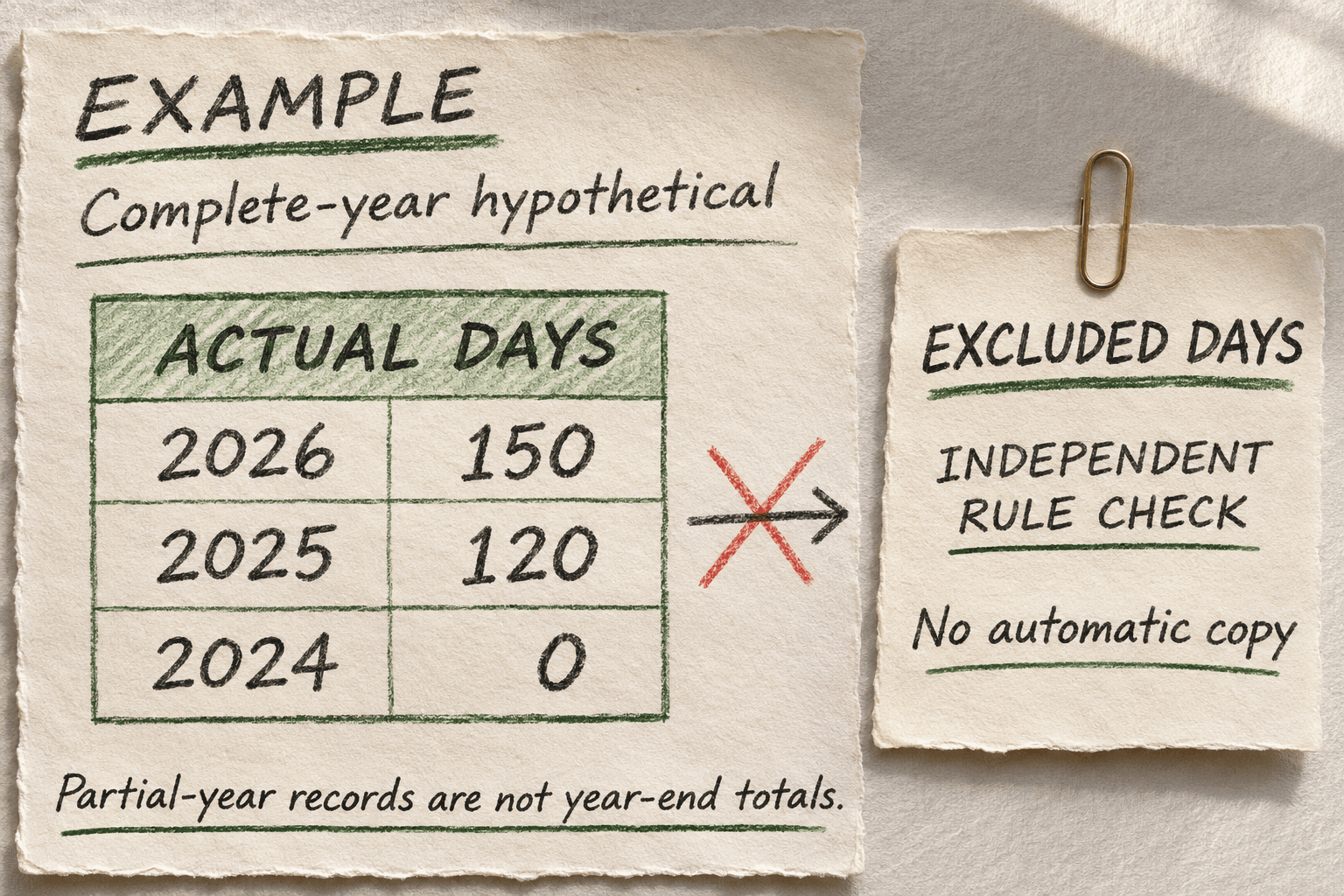
AI-generated editorial illustration of the fictional worksheet. It is not an IRS form or an eligibility determination.
Keep private identifiers out of shared teaching worksheets. In this example, a passport number is [MASKED PASSPORT] and any TIN is [MASKED TIN]. Those strings, like SAMPLE ADDRESS below, are editorial placeholders, not values to submit.
Complete Part I from your actual source records
Use the following map alongside the official page, not as a substitute for reading its instructions.
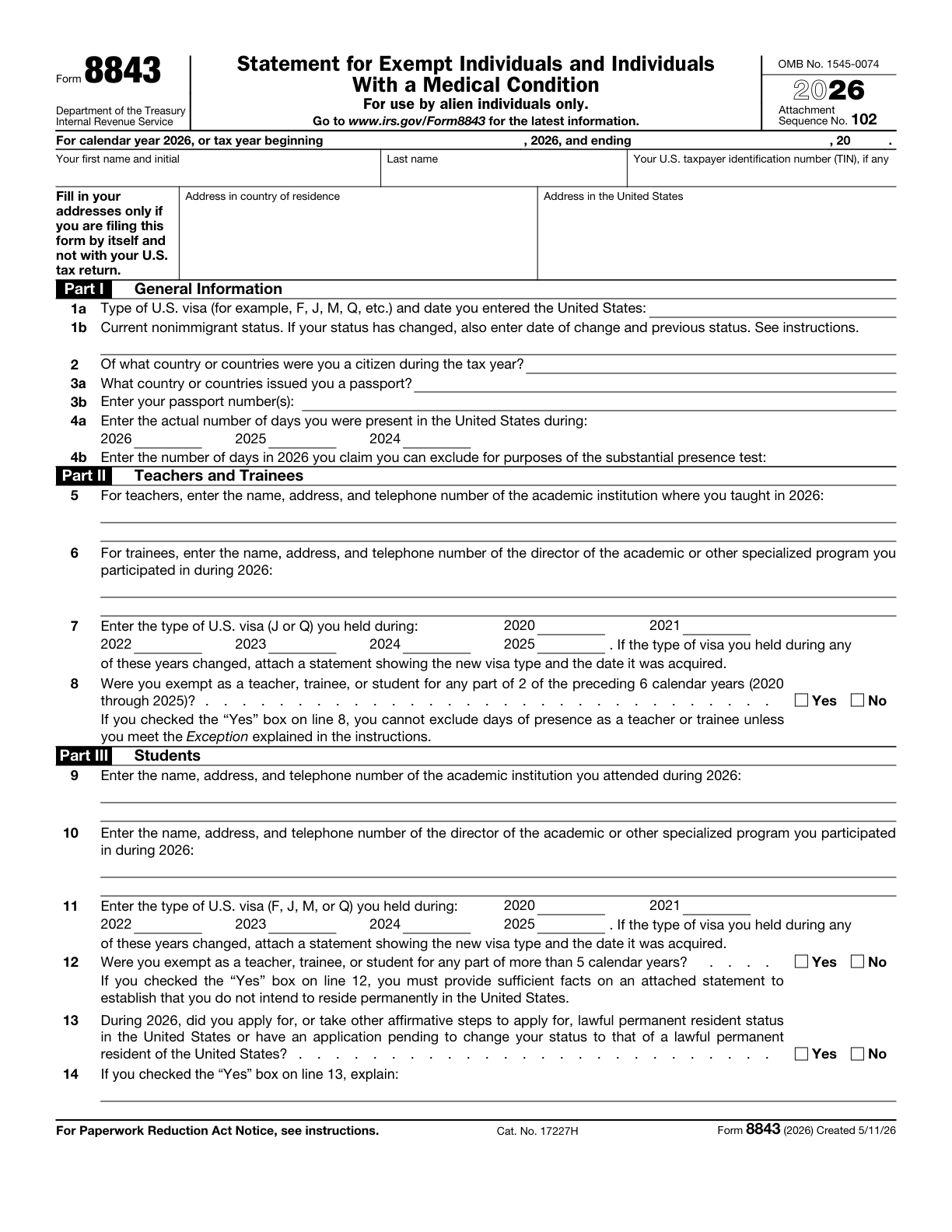
Official IRS Form 8843 (2026), page 1. The blank fields are shown as issued, with no fictional answers added. Open the source PDF.
| Field | What the 2026 form requests | Review before entering it |
|---|---|---|
| Name and TIN heading | First name and initial, last name, and U.S. taxpayer identification number, if any | Use your own information. Do not invent a TIN to finish an example. |
| Address fields | Address in country of residence and address in the United States | The printed direction says to fill these only when filing the form by itself, not with your U.S. tax return. |
| 1a | Type of U.S. visa and date you entered the United States | The specific instructions use the corresponding most recent entry date. |
| 1b | Current nonimmigrant status; if changed, the date of change and previous status | The instructions specify status as of the last day of the tax year. A November record cannot settle an unobserved year-end fact. |
| 2 | Country or countries of citizenship during the tax year | Check the actual year and records. |
| 3a and 3b | Passport-issuing country or countries, and passport number or numbers | Verify privately against the source documents. |
| 4a | Actual presence in 2026, 2025 and 2024 | Keep the three year labels and their raw counts aligned. |
| 4b | Days in 2026 claimed as excluded for the substantial presence test | Supply a separately supported count. |
Source: Form 8843, page 1, and Part I Specific Instructions, page 3.
There is a conditional shortcut when attaching Form 8843 to Form 1040-NR. If you provide the requested information on the corresponding lines of Form 1040-NR, the instructions permit you to omit lines 1a through 4a on Form 8843, with “Information provided on Form 1040-NR” entered on line 1a. They still require line 4b and the rest of Form 8843. Check the corresponding information, including Schedule OI, before using that shortcut; an intention to attach a return is not enough. For separate filing, the instructions require all entries on the form, read with the directions for the applicable parts. Part I Specific Instructions, page 3.
Identify the applicable part and who supplies its facts
Part I holds general information. The remaining parts ask different questions of different categories. First establish which rules apply; a checkbox or a completed student example cannot establish that for you.
| Part | Records and roles to check | Follow-up that matters |
|---|---|---|
| II: Teachers and Trainees | Line 5 asks teachers for the academic institution's name, address and phone. Line 6 asks trainees for the program director's details. Line 7 asks for J or Q visa history for 2020-2025. | Attach the required visa-change statement when applicable. A “Yes” on line 8 requires checking the teacher/trainee exception. |
| III: Students | Lines 9-10 ask for the academic institution and program director details. Line 11 asks for F, J, M or Q visa history for 2020-2025. | Check visa-change statements and the separate questions and explanations on lines 12-14. |
| IV: Professional Athletes | Lines 15-16 ask for charitable sports events, competition dates, and beneficiary charitable organizations' names and EINs. | Attach a statement verifying that all net proceeds of the events went to the listed organizations. |
| V: Medical Condition or Medical Problem | Lines 17a-17c ask for the condition, intended departure date before its onset, and actual departure date. | The physician or other medical official completes line 18. An editor cannot supply that certification. |
Sources: form pages 1-2 and category instructions, pages 3-4.
Preserve the Q-visa distinctions
For a qualifying teacher/trainee case with a Q visa, the instructions direct completion of Part I and only lines 6-8 of Part II. Line 6 uses the cultural exchange program director's name, address and phone. For a qualifying student case with a Q visa, they direct Part I and only lines 10-14 of Part III, with the cultural exchange program director's details on line 10. Do not copy every institution field just because it appears in the part. Specific Instructions, page 4.
Read exceptions as complete conditions
For teachers and trainees, the instructions limit exclusion where the person was exempt as a teacher, trainee or student for part of two of the six prior calendar years. The exception requires all four of these conditions:
- Exempt status as a teacher, trainee or student for part of three or fewer of those six prior years.
- All compensation during 2026 paid by a foreign employer.
- Presence in the United States as a teacher or trainee in at least one of those six prior years.
- All compensation in each of those prior years of teacher/trainee presence paid by a foreign employer.
Someone meeting that exception must also attach the information verifying the foreign-employer compensation described in the instructions. Do not reduce the exception to one employer fact. Teachers and Trainees, page 4.
For students, the instructions address exemption as a teacher, trainee or student for part of more than five calendar years, and the need in that situation to establish no intent to reside permanently in the United States. They identify facts and circumstances including closer connection and steps toward lawful permanent residence. This guide does not decide that question. Students, page 4.
For the medical category, the instructions concern days a person intended to leave but could not because of a condition or problem arising while in the United States. They also exclude specified circumstances: entering or returning for medical treatment; a preexisting condition known before arrival; or remaining beyond a reasonable period to arrange departure after becoming able to leave. Read those limitations and have the responsible physician or other medical official supply the required statement. Medical Condition or Medical Problem, pages 2 and 4.
Use institutional records for the student excerpt
Continue the fictional worksheet only if Part III is the applicable part. The following entries demonstrate where institutional facts belong. Every sample identity, address and contact label is EXAMPLE material, not a suggested answer for a real filing.
| Line | EXAMPLE worksheet entry | What a real filer must establish |
|---|---|---|
| 9 | SAMPLE COLLEGE; SAMPLE ADDRESS; [EXAMPLE PHONE] | The institution attended during 2026 and its actual address and phone, subject to the Q-visa distinction above. |
| 10 | SAMPLE PROGRAM DIRECTOR; SAMPLE ADDRESS; [EXAMPLE PHONE] | The appropriate program director's actual name, address and phone. |
| 11 | Not supplied in this fictional record | The actual visa type for each of 2020, 2021, 2022, 2023, 2024 and 2025; attach a statement with new visa types and acquisition dates if a type changed during those years. |
| 12 | No sample checkbox selected | Whether the person was exempt as a teacher, trainee or student for any part of more than five calendar years. A “Yes” requires the attached facts specified on the form. |
| 13 | No sample checkbox selected | Whether, during 2026, the person applied, took affirmative steps to apply, or had a pending application to change to lawful permanent resident status. |
| 14 | No sample explanation supplied | An explanation if the actual answer to line 13 is “Yes.” |
Source: Part III, page 1, and its instructions on page 4.
Mina's supplied travel totals do not answer any of the unresolved history or status questions. Keep those questions open in the worksheet until the relevant records and rules support an answer. Do not carry the student excerpt into the athlete or medical part.
Once your own facts are ready, download the current IRS PDF, then open Fylune and choose your file for manual entry and review. This guide uses the upload workflow; a built-in Form 8843 template and form-specific AI assistance have not been verified. Fylune does not submit the form.
Prepare the uploaded PDF and inspect the saved copy
Use Choose a File in the editor to open the official PDF from your device. Check the imported pages and supported fields before entering private information. Fylune's PDF editor supports PDF fields, text additions and visible signatures, followed by review and export. That editing capability does not verify a visa, determine tax residence or provide a required medical statement.
- Confirm the file says 2026 and all four original pages are present.
- Enter only facts supported by your records. Keep the three actual-presence totals in 4a separate from the excluded-day input in 4b.
- Review field placement, year labels, institution or program details, and each applicable follow-up. Keep required statements with the filing packet.
- Leave certification and signature steps to the responsible person and the filing route's requirements. A visible signature mark is not proof that an agency accepts that signing method, and it is not a certificate-based digital signature service.
- Download the copy and reopen it. Check the relevant pages for clipped entries, missing text, shifted marks and incorrect page order. Review separate attachments too.
The Web editor saves progress automatically to an account-owned cloud store. Treat this as a cloud workflow when deciding where to enter passport, TIN, status or medical information. The desktop storage policy is different and does not make a Web upload local-only.
Free PDF exports include a watermark; clean exports have paid options. Review the actual export options and final file before relying on it. A payment or a clean download does not guarantee IRS acceptance. For the general file-route and export checks, see how to fill out a PDF form online and check the download.
Review the attachment, address and signature context
The IRS 8843 instructions make the filing context matter. Establish whether you must file a tax return, then follow the applicable route in When and Where To File. Do not choose standalone filing just because you have finished the PDF. General Instructions, page 3.
| Filing context in the 2026 instructions | Address and signature check | Submission instruction |
|---|---|---|
| Filing a 2026 Form 1040-NR | The form's address fields and its personal “Sign here” block are marked for separate filing, not filing with a U.S. tax return. Follow the return's own requirements as well. | Attach Form 8843 to Form 1040-NR. Mail the return by its due date, including extensions, to the address in the return instructions. |
| Not required to file a 2026 tax return | Follow the standalone address and personal-signature directions and complete the required entries and applicable statements. | The current instructions direct mailing Form 8843 to Department of the Treasury, Internal Revenue Service Center, Austin, TX 73301-0215, by the Form 1040-NR due date, including extensions. |
Sources: printed address direction, page 1, personal-signature block, page 2, and When and Where To File, page 3.
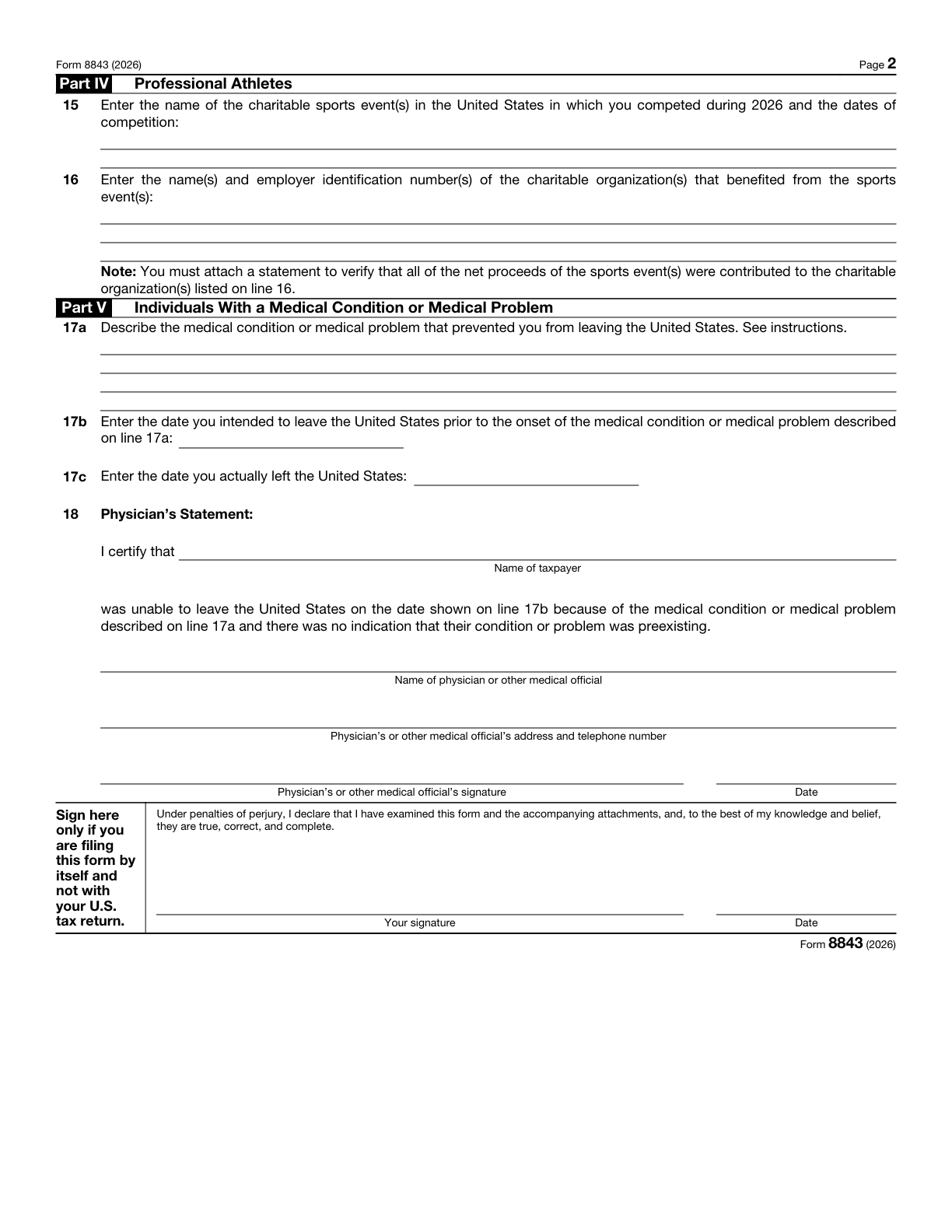
Official IRS Form 8843 (2026), page 2. Line 18 and the personal-signature block have different roles. Open the source PDF.
The personal-signature direction does not remove the separate medical professional's role on line 18 when that part applies. Check the current instructions before sending the packet, including the applicable deadline, address, attachments and signing requirements. There is no single calendar deadline stated here for every reader. Submit through the authorized route yourself; an edited or downloaded file is not a filing receipt.
Final example and review checklist
Use this checklist on your own records, not by copying Mina's fictional entries:
- Confirm the form edition and the actual filing year. For the worked example, the printed year is 2026.
- Reconcile complete actual travel records for each year in 4a. Do not use a November projection or weighted substantial-presence figures.
- Establish the basis and number of excluded days for 4b separately. Equal numbers need a supported reason.
- Verify the most recent entry, year-end status, any status change, citizenship and passport facts. Keep private identifiers out of shared examples.
- Complete the applicable part and follow its Q-visa distinctions, prior-year questions, explanations and attachment requirements.
- Replace every EXAMPLE label, SAMPLE ADDRESS and masked identifier with the correct information where required. Never submit editorial placeholders.
- Keep institutional facts tied to real records and physician or other medical official certifications with the responsible professional.
- Check the real attachment or standalone context before using the address fields, personal-signature block or conditional 1040-NR shortcut.
- Reopen the exported PDF and inspect the relevant pages and all attachments. Check legibility, page order and the final export's watermark or other changes.
- Resolve eligibility and deadline questions using the current agency rules or an appropriate qualified adviser, then submit separately through the authorized route.
Keep the worksheet with the records and explanations supporting your entries. Completing it does not establish exempt status.
Sources
- IRS About Form 8843: current-revision link, purpose and recent developments.
- IRS Form 8843 (2026), including instructions: pages 1-2 for the fields and signature blocks; page 3 for filing context and Part I; pages 3-4 for category rules and exceptions.
- Fylune PDF editor: supported PDF editing and export workflow.
- Fylune editor: file upload entry. Follow the agency's instructions for filing after export.