

For the 2025 tax year, prepare one record set for each student before entering totals on Form 8863. Start with the student's identity and school details, then reconcile payment records, tax-free educational assistance, refunds, enrollment facts, and prior American Opportunity Credit claims. A Form 1098-T belongs in that record set, but it does not by itself establish the expense amount or eligibility.
This guide uses the 2025 Form 8863 and the matching 2025 IRS instructions. The IRS Form 8863 instructions page currently identifies those instructions as 2025. Do not carry the line references, limits, or dates in this example into another tax year without checking that year's form and instructions.
This is a document-preparation guide, not tax advice. The IRS rules govern eligibility, credit amounts, and the return filing process.

What Form 8863 does in 2025
Form 8863 covers two education credits. The American Opportunity Credit can be as much as 2,000 per return and is nonrefundable. You may claim both types on one return, but not for the same student in the same tax year. These are maximums and categories, not a conclusion that a student or filer qualifies. The IRS comparison table lists the different rules.
For both credits in 2025, the IRS instructions state a MAGI limit of 90,000 for single, head of household, or qualifying surviving spouse. The phaseout range is 180,000 for a joint return and 90,000 for the other listed filing statuses. Form 8863 applies those limits in Parts I and II. Use the matching tax-year return and instructions when determining the MAGI figure to enter.
The two credits also treat some expenses differently. For the American Opportunity Credit, course materials needed for a course of study may qualify whether or not the institution requires the student to buy them from the school. For the Lifetime Learning Credit, books, supplies, and equipment count only when payment to the institution is required as a condition of enrollment or attendance. Personal expenses such as room and board, insurance, medical expenses, and transportation do not qualify under these instructions.
Build one source-record set per student
Do not start by copying the number in Form 1098-T, box 1, onto Form 8863. The IRS says box 1 may differ from the amount paid or treated as paid for the year, and qualified expenses must be reduced under the adjusted-expense rules. Gather the records first.
| Record to gather | What to verify | Where it matters |
|---|---|---|
| Student identity record and the tax return | Name and SSN or other applicable TIN exactly as shown on page 1 of the return | Part III, lines 20 and 21 |
| Institution record | School name, address, 2025 Form 1098-T status, any 2024 Form 1098-T with box 7 checked, and EIN when required | Part III, line 22 |
| Form 1098-T, if received | School identity and reported payments; do not treat box 1 as the final adjusted expense | Line 22 questions and the expense reconciliation |
| Payment evidence | Amount paid, payment date, payer, academic period, and the item paid for | Adjusted Qualified Education Expenses Worksheet |
| Scholarship, grant, employer assistance, veterans' assistance, and refund records | Tax treatment, amount, allocation to each academic period, and date received | Reductions in the adjusted-expense worksheet |
| Enrollment evidence | Eligible institution, program or credential status, and half-time status for the relevant period | American Opportunity Credit review, especially line 24 |
| Prior-credit record | Number of earlier tax years in which the American Opportunity Credit was claimed for this student | Line 23 |
| Education-history and conviction answers | Whether the first four postsecondary years were completed before 2025 and the line 26 controlled-substance felony question | Lines 25 and 26 |
| Return-level facts | Filing status, MAGI source, dependency treatment, and tax-liability worksheet inputs | Parts I and II |
If the student did not receive Form 1098-T, do not replace the IRS exception rules with a guess. The 2025 instructions describe limited paths when the institution was not required to furnish the form, or when a required form was not provided before filing. Those paths include additional conditions and substantiation requirements. Keep the issue open until the facts and instructions support an answer.
Reconcile paid expenses, assistance, and refunds
For each student and each relevant academic period, use the worksheet in the 2025 instructions for Form 8863:
- Record total qualified education expenses paid in 2025 for that academic period.
- Subtract tax-free educational assistance allocated to the period, including applicable assistance received in 2025 and assistance received in 2026 before the 2025 return is filed.
- Subtract qualifying refunds of 2025 expenses received in 2025 or in 2026 before the return is filed.
- Treat the result as adjusted qualified education expenses. If the result is zero or less, enter zero.
The worksheet is one reason billed amounts, Form 1098-T amounts, payment records, and the final Form 8863 amount can differ. The IRS also directs the filer to use amounts paid or treated as paid in 2025, subject to the credit's expense rules and the required reductions. A payment made in 2025 for an academic period beginning in the first three months of 2026 may be treated under the 2025 rules. A payment made in 2024 or 2026 cannot be used to figure the 2025 credit.
Keep the reconciliation at the student and academic-period level. Combining two students too early makes it harder to trace a scholarship, refund, or payment back to the right Part III.
Complete Part III before Parts I and II
The official two-page form tells you to complete a separate Part III on page 2 for each student before completing Parts I and II on page 1.
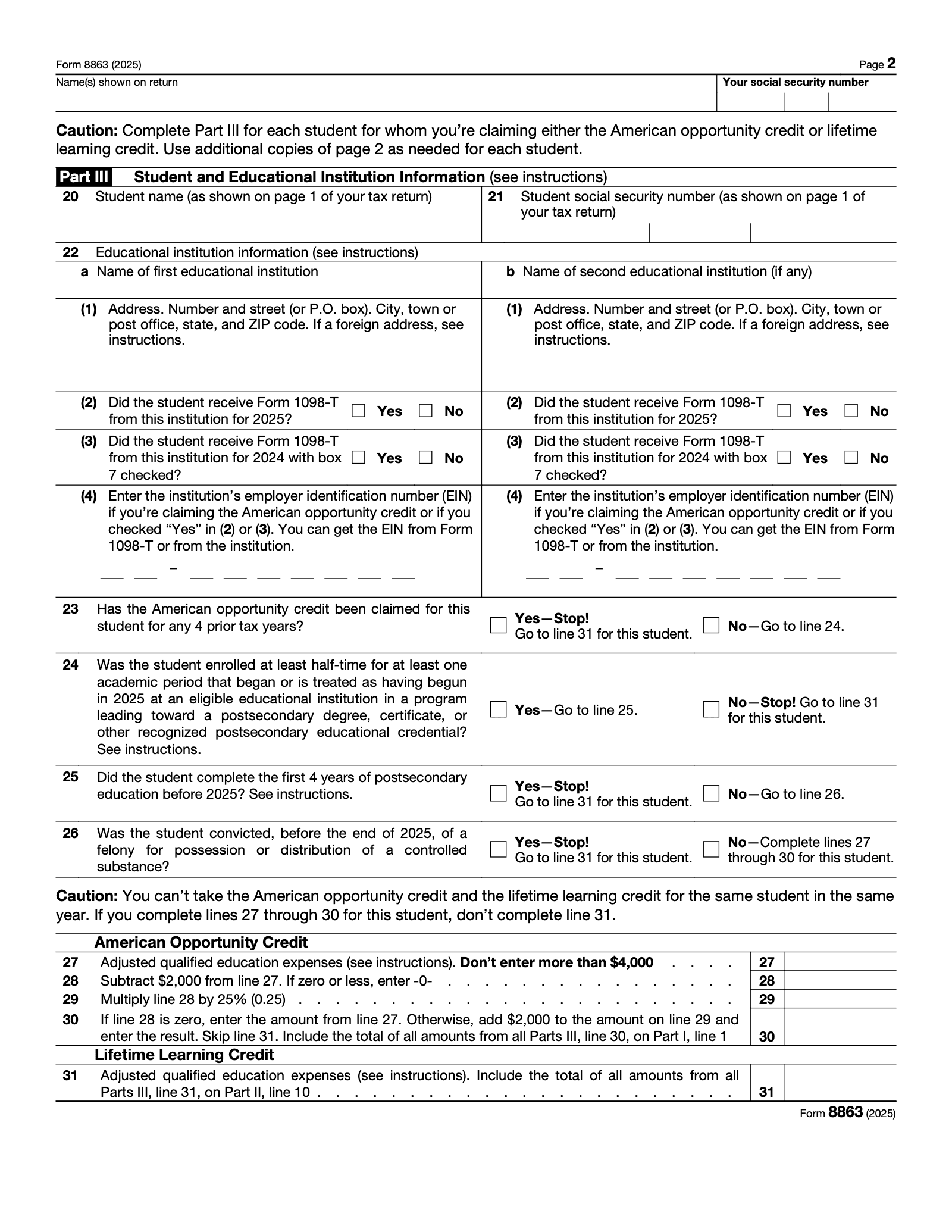
Official 2025 Form 8863, page 2. This unfilled IRS page is shown for field orientation. Use the linked official PDF as the source document.
Use this order for each student:
- Enter the student's return-matching name and TIN on lines 20 and 21.
- Complete line 22 for each institution. If a student attended more than two institutions, the instructions call for an additional page 2 completed only through line 22.
- Answer lines 23 through 26 from records. These questions direct whether the American Opportunity Credit section can be completed or whether the form routes to line 31 for the Lifetime Learning Credit.
- After the credit selection is supported, enter adjusted qualified education expenses on line 27 for the American Opportunity Credit or line 31 for the Lifetime Learning Credit. Do not complete both routes for the same student.
- Only after every student's Part III is complete should you total line 30 amounts into Part I, line 1, or line 31 amounts into Part II, line 10.
Line 22(4) deserves a separate check. The 2025 form asks for the institution's EIN when claiming the American Opportunity Credit or when "Yes" is checked for either Form 1098-T question in line 22. The instructions also state that the EIN must be provided when the American Opportunity Credit is claimed for that student.
Fictional preparation example with unresolved facts
This example demonstrates the record flow without inventing a student's facts or a credit result. "Student A" is a fictional label. Every value must come from the filer's own records.
Let:
Pequal qualified expenses supported by payment records for Student A and the relevant academic period.Sequal tax-free educational assistance allocated to that period.Requal qualifying refunds allocated to that period.Aequal adjusted qualified education expenses, calculated asP - S - R, but not less than zero.
| Student A ledger item | Source record | Prepared value | Review state |
|---|---|---|---|
| Student name and TIN | Page 1 of the return | Not supplied | Leave lines 20 and 21 unanswered until matched |
| Institution details and EIN | Form 1098-T or institution record | Not supplied | Leave line 22 unanswered until verified |
Qualified paid expenses (P) | Receipts, account statements, and payment evidence | Not supplied | Classify under the chosen credit's expense rules |
Tax-free assistance (S) | Scholarship, grant, employer, or veterans' assistance record | Not supplied | Determine allocation and tax treatment from records |
Refunds (R) | Institution refund record | Not supplied | Match the refund to the payment and academic period |
Adjusted expenses (A) | P - S - R, floor at zero | Cannot calculate | Do not enter line 27 or 31 yet |
| Prior AOTC years | Prior returns or transcripts | Not supplied | Line 23 remains unanswered |
| Half-time and program facts | Institution enrollment record | Not supplied | Line 24 remains unanswered |
| First four years completed | Institution academic record | Not supplied | Line 25 remains unanswered |
| Line 26 condition | Filer-provided fact | Not supplied | Line 26 remains unanswered |
This ledger is intentionally incomplete. A PDF editor should not convert missing eligibility facts into "No," infer an EIN, choose a credit, or promise a refund.
Reconcile all students and review the return handoff
Before moving totals to page 1, compare every student sheet against its evidence:
- Each student has a separate Part III.
- Names and TINs match page 1 of the return.
- Institution details and conditional EIN entries match the supporting record.
- Form 1098-T answers reflect the correct years and box 7 question.
- Each expense is supported, assigned to the right student and academic period, and classified under the selected credit's rules.
- Tax-free assistance and refunds have been deducted where the instructions require it.
- Lines 23 through 26 match source facts rather than assumptions.
- No student has both line 27 through 30 entries and a line 31 entry.
- Part I and Part II totals agree with the completed Part III sheets.
- The MAGI and Credit Limit Worksheet inputs come from the matching 2025 return package.
Download the official 2025 Form 8863 PDF first. Then choose the file in Fylune to prepare and review your copy. Inspect page 2 for every student's Part III, then page 1 for the combined totals. Fylune's Web editor lets you choose a PDF from your device and saves Web work as account-owned cloud snapshots. Free PDF exports include a watermark, while clean export options are paid. Fylune does not file the form with the IRS, and no Form 8863-specific AI filling capability is claimed here.
For other source-backed government-form guides, visit the Fylune Blog.
Questions about this preparation workflow
Is Form 1098-T enough to complete Form 8863?
No. The 2025 IRS instructions say the amount reported on Form 1098-T may differ from the amount paid or treated as paid for the credit. You also need payment support and the records required to calculate adjusted qualified education expenses.
Do I complete page 1 first?
No. Complete a separate Part III on page 2 for every student before completing Parts I and II. Use extra copies of page 2 when needed.
Can the same student use both education credits for 2025?
No. The 2025 form says not to complete line 31 when lines 27 through 30 are completed for that student. The two credits can appear on the same return only for different students who meet their respective rules.
What should I do when an eligibility answer is missing?
Leave the answer unresolved, retrieve the supporting record, and check the matching 2025 IRS instructions. Do not infer a favorable answer from a payment record or Form 1098-T.
Official sources
- 2025 Form 8863, Education Credits, Internal Revenue Service
- Instructions for Form 8863 (2025), Internal Revenue Service
- 2025 Instructions for Form 8863 PDF, Internal Revenue Service
- Fylune Web editor, for the manual PDF upload and review workflow described above