

For a 2025 Form 8889, begin with the records, not the blank lines. Separate personal contributions from employer and cafeteria-plan contributions, match every HSA distribution to Form 1099-SA, and test each claimed qualified expense against the IRS conditions. Then use the official 2025 Form 8889 together with the 2025 IRS instructions.
These instructions for Form 8889 focus on the review work a document can support. If you are learning how to fill out Form 8889, start by identifying which facts belong to each part and which facts are still missing. The official IRS Form 8889 instructions control the final treatment.
This guide is a preparation and review workflow for the 2025 edition. It does not decide whether you were eligible to contribute, whether an expense qualifies, or how the IRS will treat your return. If your coverage, contribution timing, rollover, excess contribution, or testing-period facts are uncertain, leave the affected line unresolved until you check the instructions or speak with a qualified tax professional.

Keep contribution sources separate from distributions and receipt matches before you enter amounts on the form.
What each part of the 2025 form does
The IRS says Form 8889 reports HSA contributions, calculates the HSA deduction, reports HSA distributions, and calculates certain income and additional tax. The form attaches to Form 1040, 1040-SR, or 1040-NR. Filing Form 8889 records the facts and calculations. It does not, by itself, establish that a contribution was permitted.
| Form section | What it reviews | Records that usually support it |
|---|---|---|
| Part I, HSA contributions and deduction | Coverage, personal contributions, employer contributions, qualified HSA funding distributions, and the resulting deduction | Month-by-month coverage records, W-2 box 12 code W, contribution confirmations, Form 5498-SA, and any qualified HSA funding distribution record |
| Part II, HSA distributions | Gross distributions, rollovers or timely withdrawn excess contributions, qualified medical expenses, taxable distributions, and any applicable additional tax | Form 1099-SA, trustee statements, rollover confirmations, receipts, reimbursement records, and expense dates |
| Part III, failure to maintain HDHP coverage | Testing-period income and additional tax tied to the last-month rule or a qualified HSA funding distribution | Coverage start and end dates, Medicare enrollment facts, and the records for the rule that created the testing period |
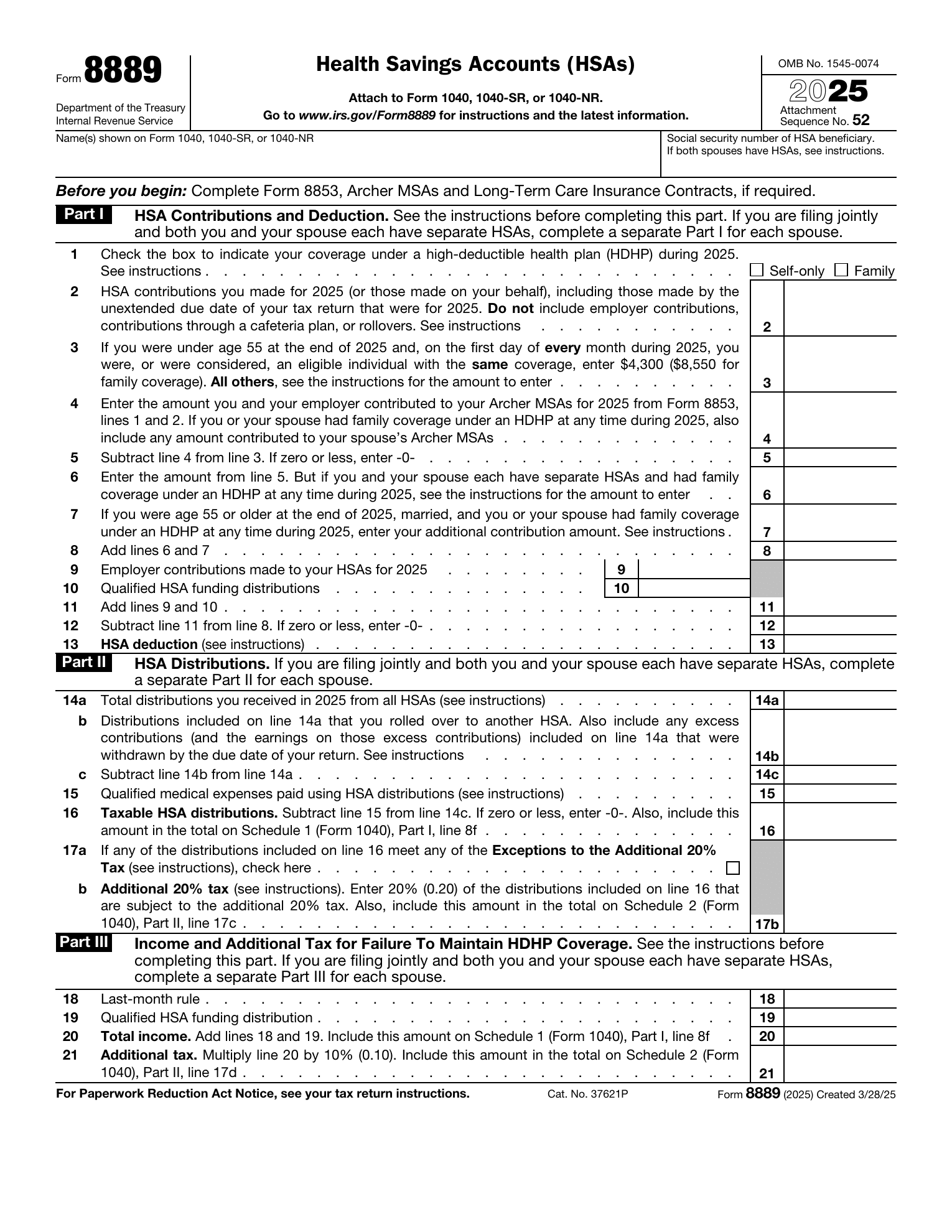
The official 2025 Form 8889 has one page. Use it with the matching 2025 instructions rather than a third-party copy from another year.
The IRS filing rules list several reasons a person must file Form 8889, including HSA contributions, an HSA distribution, or a testing-period failure. They also say a person who received an HSA distribution in 2025 must file Form 8889 with the applicable individual income tax return even if there is no taxable income or other filing reason.
Gather the records before filling any line
Create one contribution ledger and one distribution ledger. Do not combine them into a single net number.
Contribution-source ledger
| Record | What to copy | What still needs review |
|---|---|---|
| 2025 Form W-2 | Box 12, code W | Whether part of the amount belongs to another contribution year, and whether a 2025 employer contribution was made in 2026 |
| Personal contribution confirmations | Amount, deposit date, account, and tax-year designation | Whether the deposit was designated for 2025 and made by the applicable deadline |
| 2025 Form 5498-SA | Box 2 total contributions, box 3 subsequent-year contributions for 2025, and box 4 rollovers | Whether the totals agree with the detailed custodian ledger and the source categories used on Form 8889 |
| Coverage records | Coverage type on the first day of each month, plus changes in coverage | Whether each month meets the IRS definition of an eligible month |
| IRA-to-HSA transfer record, if any | Date, source IRA, destination HSA, and amount | Whether it meets the instructions for a qualified HSA funding distribution |
Form 5498-SA is a cross-check, not a substitute for source classification. The 2025 Form 5498-SA separates total contributions made in 2025, contributions made in 2026 for 2025, and rollover contributions. That timing can explain why a total does not match a simple calendar-year bank search.
Distribution-to-receipt ledger
Use one row for each withdrawal or reimbursement event.
| Distribution record | Gross amount | Rollover or timely excess withdrawal | Expense date | Receipt amount | Reimbursed elsewhere? | Review result |
|---|---|---|---|---|---|---|
| Form 1099-SA or trustee entry | unresolved |
The 2025 Form 1099-SA instructions for recipients explain that the payer reports the distribution but does not compute the taxable amount. That is why Form 1099-SA, by itself, cannot establish how much belongs on Form 8889 line 15.
Map personal and employer contributions without double counting
Part I keeps the sources separate.
- Use line 1 for the coverage box required by the 2025 form. If coverage changed, follow the line 1 instructions rather than choosing from memory.
- Use line 2 for contributions you made, or that others made on your behalf, for 2025. The line 2 instructions exclude employer contributions, cafeteria-plan payroll contributions, rollovers, and qualified HSA funding distributions.
- Determine line 3 from the month-by-month coverage facts and the instructions. Do not assume that having an HSA establishes eligibility for every month.
- Complete lines 4 through 8 from the facts that apply to you, including any Archer MSA amount, spouse allocation, or additional contribution amount.
- Use line 9 for employer contributions. The IRS treats employee payroll contributions through a cafeteria plan as employer contributions for this purpose. The instructions point to Form W-2 box 12, code W, and provide an employer contribution worksheet when contributions span tax years.
- Use line 10 only for a qualified HSA funding distribution described in the instructions. A normal HSA-to-HSA rollover does not belong there.
- Follow lines 11 through 13 in order. The line 13 instructions generally use the smaller of line 2 or line 12, but excess contributions and prior-year excess contributions can require more work.
A reconciliation error to watch for is copying W-2 code W to line 9 and also including the same cafeteria-plan payroll amount on line 2. Keep the W-2 source row visible beside the personal contribution row so the same dollars cannot enter both fields.
Reconcile distributions before deciding what is tax-free
Part II starts with gross distributions, not with receipts.
- Add the box 1 amounts from all 2025 Forms 1099-SA for the HSA beneficiary and reconcile the total to trustee statements. The line 14a instructions direct the gross total to line 14a.
- Review each possible line 14b item separately. The 2025 instructions include qualifying HSA rollovers and certain timely withdrawn excess contributions and earnings in this line.
- Subtract line 14b from line 14a to reach line 14c.
- Build line 15 from supported expense matches, not from a guess. The line 15 instructions limit this amount to HSA distributions used for qualified medical expenses that were not reimbursed by insurance or other coverage and that were incurred after the HSA was established.
- Follow the form for line 16 and lines 17a and 17b. Do not assume every amount left after line 15 is subject to the additional 20% tax because the instructions list exceptions.
A medical receipt is evidence of an expense, but it does not answer every line 15 condition. Your ledger should also show who incurred the expense, when it was incurred, whether another source reimbursed it, and which distribution amount the receipt supports.
Review Part III only when the testing-period rules apply
Part III is not a general eligibility questionnaire. The 2025 Part III instructions use it for a failure to remain an eligible individual during a testing period tied to either the last-month rule or a qualified HSA funding distribution.
For the last-month rule, the IRS describes a testing period that begins with the last month of the tax year and ends on the last day of the following 12th month. A different testing period applies to a qualified HSA funding distribution. Record the coverage facts and dates first. If you cannot determine whether a testing period began or whether an exception applies, do not ask a document editor to make that tax decision.
Fictional preparation example with unresolved amounts
This example is fictional. It shows the record path but intentionally leaves dollar amounts blank because no taxpayer facts were supplied.
Morgan has four records in a 2025 preparation folder:
| Known record | Form 8889 review step | What remains blank or unresolved |
|---|---|---|
| A 2025 W-2 with box 12 code W | Place the verified 2025 employer contribution total in the line 9 worksheet, not line 2 | The amount and any cross-year adjustment |
| A personal deposit confirmation marked for tax year 2025 | Test it against the line 2 timing and source rules | The amount and whether all timing facts are complete |
| A 2025 Form 1099-SA | Reconcile box 1 to trustee statements and line 14a | The gross distribution amount |
| A folder of medical receipts | Match each receipt to the line 15 conditions and the distribution ledger | The supported qualified-expense total and any unmatched distribution |
Morgan also needs month-by-month coverage facts before completing line 3 and any applicable testing-period review. Morgan should leave each unknown blank, mark the missing input, obtain the record, and then resume the form.
Prepare and inspect the PDF in Fylune
Download the official 2025 Form 8889 PDF, then choose that file in the Fylune browser editor. The editor accepts a PDF chosen from your device. Enter only facts you can support, inspect the downloaded copy, and keep the final evidence ledgers with your tax records.
Fylune does not file the form with the IRS and does not determine HSA eligibility or tax treatment. Review every field yourself and follow the filing method for your tax return. In the Web editor, files save as account-owned cloud snapshots. Free PDF exports include a watermark, while clean export options are paid.
Before you use the downloaded file, check:
- The form and instructions both say 2025.
- The name and Social Security number match the HSA beneficiary and the attached return.
- Line 2 excludes the line 9 employer and cafeteria-plan amounts.
- Any rollover is mapped to the correct line and not counted as a deductible personal contribution.
- Line 14a reconciles to all Forms 1099-SA and trustee statements.
- Every line 15 amount has a matching record and satisfies the stated IRS conditions.
- Part III is completed only if the applicable testing-period facts require it.
- Both spouses have separate Forms 8889 where the instructions require them.
- The downloaded PDF opens, all intended entries are visible, and no unresolved placeholder remains.
For more government-form preparation guides, visit the Fylune Blog.
Questions about this preparation task
Do cafeteria-plan payroll contributions go on line 2?
No. The 2025 IRS instructions treat payroll contributions through a salary reduction agreement as employer contributions. Review them with line 9 and the W-2 box 12 code W amount.
Can I copy Form 1099-SA box 1 to line 15?
No. Box 1 supports the gross distribution total for line 14a. Line 15 requires a separate review of qualified medical expenses, reimbursement status, and the date the HSA was established.
Does every HSA-to-HSA movement count as a rollover on line 14b?
No. The IRS instructions distinguish a rollover received and reinvested within the applicable rules from a direct trustee-to-trustee transfer. A direct transfer is not reported as a distribution on line 14a.
Should I complete Part III whenever my coverage changed?
Not automatically. Part III addresses specified testing-period failures tied to the last-month rule or a qualified HSA funding distribution. Use your coverage facts and the 2025 instructions to determine whether it applies.
Official sources
- 2025 Form 8889
- 2025 Instructions for Form 8889
- IRS page for Form 8889
- 2025 Form 5498-SA
- 2025 Form 1099-SA
This article is for document preparation and record review. It is not tax or legal advice.