

By Nina@Aurcue, Chief Marketing Officer at Aurcue
Form 941-X is for correcting an error on a Form 941 that was already filed. If the original return was never filed, the IRS says to file Form 941 instead. Start by locking the correction to one quarter and one calendar year, recording when the error was discovered, and building a source packet that explains every changed amount.
This guide follows the IRS Form 941-X, Rev. April 2026 and its matching official instructions. It helps you prepare and review a PDF copy. It does not decide tax eligibility, amend an IRS account, file a claim, or guarantee a refund.
Short answer: compare the previously reported quarter with corrected payroll records, choose the Part 1 process only after applying the IRS instructions to the actual facts, enter each difference in Part 3, complete the applicable certifications, explain every correction, and have an authorized person sign the complete form.
Confirm that you are correcting an already-filed quarter
The first check is simple: did the business already file Form 941 for the quarter at issue? The IRS instructions for Form 941-X say not to use Form 941-X when the original Form 941 was never filed. Worker reclassification has separate instructions, so do not treat it as a routine exception.
If you are preparing the original quarterly return, use the Fylune Form 941 record-review guide instead. Form 941-X starts after a filed return needs correction.
Create a cover note for the correction packet with these facts:
- the return type being corrected;
- the exact quarter, numbered 1 through 4;
- the calendar year of that quarter;
- the date the error was discovered; and
- the source record that established the error.
Use one Form 941-X for each quarter. If the review finds errors in two quarters, build two packets. The IRS also says to enter the quarter and calendar year again on pages 2 through 5. When several errors were discovered on different dates, the instructions call for the earliest discovery date at the top of page 1 and the later dates in the Part 4 explanation.
Build a source packet before entering amounts
Do not start with blank fields and work backward. Start with the filed return and the payroll records that support the corrected result.
| Record | What to compare | What it supports on Form 941-X |
|---|---|---|
| Copy of the filed Form 941 | The amount originally reported, including any previous correction | Part 3, Column 2 |
| Corrected payroll register for the same quarter | Quarter totals for wages, withholding and applicable payroll-tax categories | Part 3, Column 1 |
| Wage statements and any Forms W-2 or W-2c workpapers | Whether wage and tax statements match the corrected payroll totals | Part 2, line 3 certification and affected Part 3 lines |
| Deposit and payment records | Whether the payroll record set agrees with the business's payment history | Review support for the correction packet |
| Employee repayment, reimbursement, consent or statement records, when applicable | Whether the selected overreporting process meets the certification facts | Part 2, lines 4 or 5 |
| Explanation log | The affected line, discovery date, difference and cause | Part 4, line 43 |
Keep the packet quarter-specific. A record from the current filing quarter does not replace a record from the quarter being corrected.
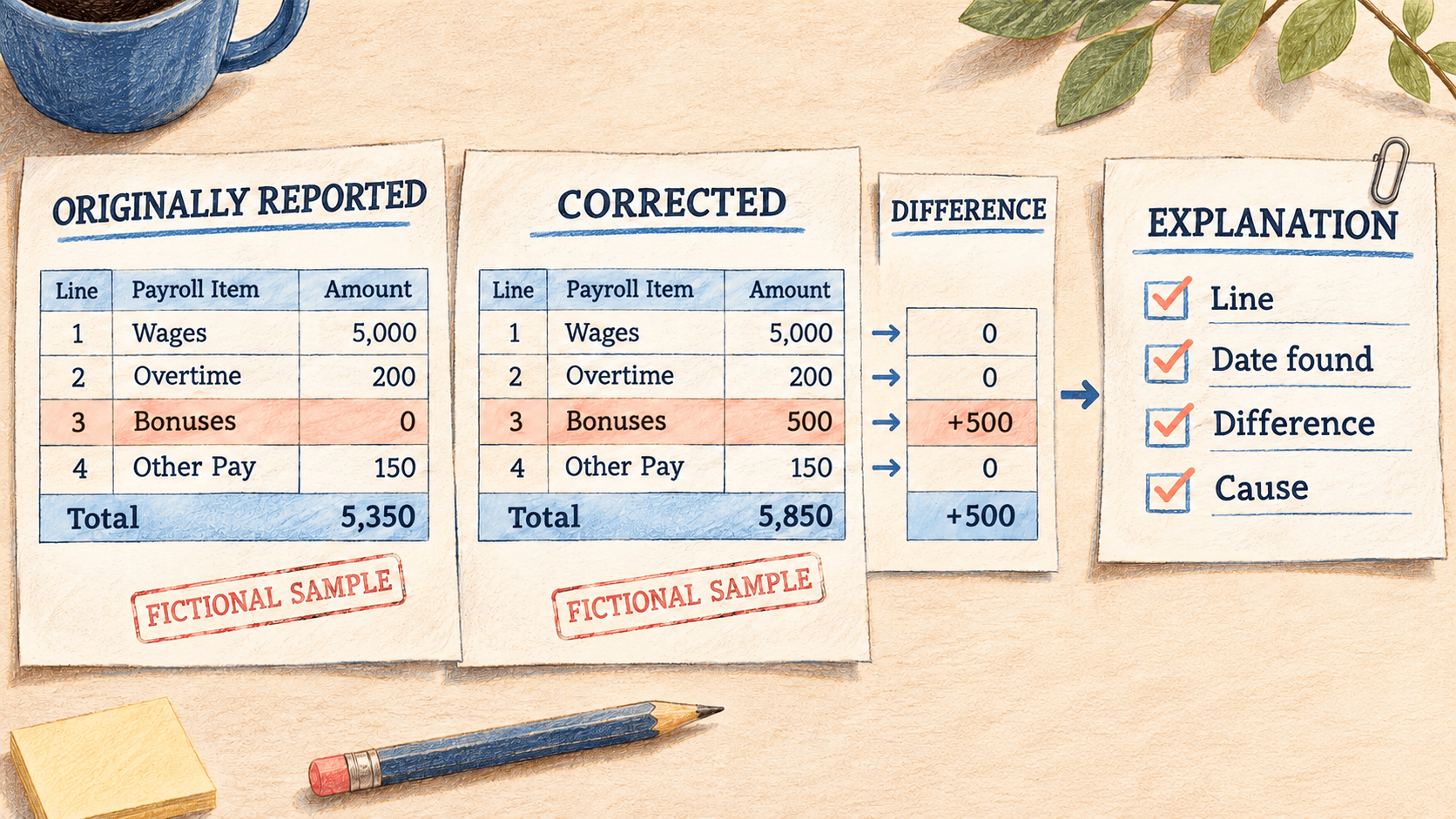
Editorial illustration. The records are fictional and do not reproduce an IRS form or contain employee data.
Review the Part 1 process against the actual facts
Part 1 requires one process. Check line 1 or line 2, not both. The choice cannot be made from the sign of one worksheet result alone because the official instructions include mixed corrections, employment-tax-credit treatment and timing limits.
| Facts to verify | Direction in the April 2026 instructions | Review question |
|---|---|---|
| The correction includes underreported tax | Use the adjustment process on line 1 | Does the packet identify the tax due and the filing/payment timing? |
| The correction includes both underreported and overreported tax amounts on the same form | Use line 1 | Are both sides of the correction explained without netting away the underlying facts? |
| The correction contains only overreported tax and the business wants a credit applied to a later return | Line 1 may be used, subject to the instructions and the open period of limitations | Is the adjustment process still available for this filing date? |
| The correction contains only overreported tax and the business wants a refund or abatement | Use the claim process on line 2 | Do the Part 2 certifications and employee records support the claim? |
| An overreported correction is filed in the final 90 days of the period of limitations | The instructions require the claim process | Has the deadline been checked for this quarter? |
| The correction changes an employment tax credit | The instructions reverse the usual tax-amount treatment for underreported and overreported credits | Has the exact credit instruction been read before selecting a process? |
If the business wants a refund or abatement for overreported amounts and also needs to report underreported amounts, the IRS instructions call for separate forms: one claim for the overreported amounts and another Form 941-X using the adjustment process for the underreported amounts.
The general period described in the April 2026 instructions is three years from the filing date for an underreported correction. For an overreported correction, it is generally three years from filing or two years from payment, whichever is later. The instructions contain deemed filing dates and special cases, so calculate the deadline from the business's records and the current IRS instructions rather than this summary.
Map corrected amounts to the Part 3 columns
Part 3 uses a before-and-after comparison. On the current official form:
- Column 1 is the total corrected amount for all employees.
- Column 2 is the amount originally reported or previously corrected.
- Column 3 is the difference: Column 1 minus Column 2. Use a minus sign for a negative amount.
- Column 4 is the tax correction. Its treatment depends on the line, so follow the line-specific instruction instead of copying Column 3 everywhere.
The image below is a real rendering of page 2 of IRS Form 941-X, Rev. April 2026. It shows the Part 3 headings and the line-specific directions for Column 4.
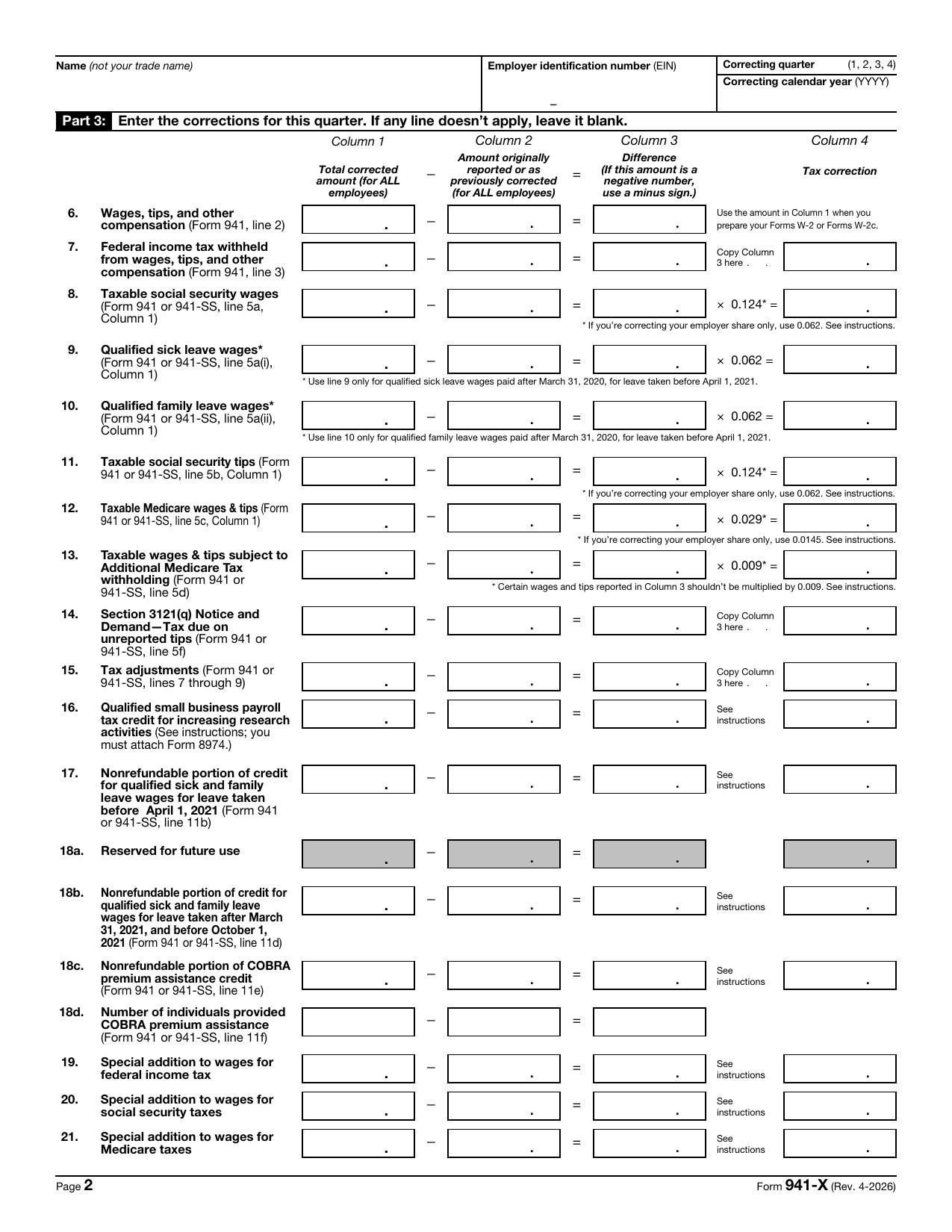
Source: IRS Form 941-X, Rev. April 2026, page 2. The image is an unfilled rendering of the official form.
Fictional reconciliation example
Assume a fictional payroll review for Quarter 2 of 2025 finds that line 6, wages, tips and other compensation, should have been 100,000 reported on the filed Form 941.
| Form 941-X entry | Fictional amount | Source record |
|---|---|---|
| Line 6, Column 1: corrected amount | $105,000 | Corrected Quarter 2 payroll register |
| Line 6, Column 2: previously reported amount | $100,000 | Filed Quarter 2 Form 941 |
| Line 6, Column 3: difference | $5,000 | 100,000 |
This example shows the column logic only. It does not establish which other wage or tax lines must change, whether a credit applies, which Part 1 process is correct, or whether any deadline has been met. Those answers require the actual payroll categories, withholding records and quarter-specific instructions.
Review certifications, explanation and signature
For Part 2, every checked box needs a supporting record. Line 3 certifies that required Forms W-2 or W-2c were or will be filed with the corrected wage and tax amounts. If every correction is an underreported tax amount, the instructions say to complete line 3 and skip lines 4 and 5. Overreported employee social security or Medicare tax can require repayment, reimbursement, consent or employee statements, depending on the process and facts. Match each checked box to a record in the packet.
Part 4, line 43 needs more than a label such as "payroll error." The IRS instructions call for the affected Form 941-X line numbers, the discovery date, the difference and the cause of each correction. If an attachment is needed, identify the business, EIN, Form 941-X, corrected quarter and corrected year at the top of the attachment as directed by the instructions.
Part 5 must be signed by a person authorized for the business entity, or by an authorized agent with a valid power of attorney on file. The IRS says to complete all five form pages and sign page 5. Review the authorized signer rules in the current instructions rather than assuming the payroll preparer can sign.
Prepare and review the PDF in Fylune
Download the official Form 941-X PDF before opening an editor. Then use the verified Fylune browser editor and choose the PDF from your device.
Enter only facts supported by the correction packet. Review every page, add the user's own signature when appropriate, and download or print a copy for the filing handoff. Fylune does not amend an IRS account, submit the form or decide whether the IRS will accept a correction. Free PDF exports include a watermark; clean export options are paid. In the Web editor, saves are account-owned cloud snapshots.
Final Form 941-X review checklist
- Confirm the PDF and instructions both say Rev. April 2026.
- Confirm the packet covers a Form 941 that was already filed.
- Match the same corrected quarter and calendar year across pages 1 through 5.
- Enter the discovery date supported by the correction log.
- Use a separate Form 941-X for every affected quarter.
- Check exactly one Part 1 process after reviewing the facts and limitations.
- Tie every Part 2 certification to wage-statement, repayment, reimbursement, consent or employee-statement records as applicable.
- Recalculate each Part 3 Column 3 amount as Column 1 minus Column 2.
- Apply the line-specific Column 4 instruction.
- Explain each changed line, discovery date, difference and cause on line 43.
- Complete all five form pages and obtain an authorized signature on page 5.
- Recheck the current IRS Form 941-X page for electronic filing information or the current paper mailing address before submission.
Questions about preparing Form 941-X
Do I use Form 941-X if the original Form 941 was never filed?
No. The IRS instructions say to file Form 941 for the missing quarter. Worker reclassification has separate rules, so read the line 42 instructions if that is the reason no original return was filed.
Can one Form 941-X correct more than one quarter?
No. The IRS requires a separate Form 941-X for each Form 941 being corrected.
Does a positive or negative difference choose the Part 1 process?
Not by itself. The selection depends on whether the packet contains underreported amounts, overreported amounts or both, the requested treatment, the period of limitations and special rules for employment tax credits.
Can Fylune submit Form 941-X to the IRS?
No. Fylune can open the official PDF for preparation and review. The user remains responsible for the facts, signature and current IRS submission route.