

By Orion Wells, Founder of Aurcue
To fill out Form 433-A, start with the official IRS PDF, choose the sections that match your income, and use your records to report assets, debts, gross monthly income and living expenses. Check the totals and supporting documents before signing. The IRS uses this collection information statement to assess how a wage earner or self-employed individual can pay an outstanding tax liability. Completing it does not establish a payment arrangement by itself. IRS Form 433-A, Publication 1854.
This guide follows the June 2026 revision, an eight-page form checked on November 4, 2026. It explains document preparation, not tax or legal advice for your situation.
Which 433 form you actually need
Check the form number in the IRS request before entering financial information. These documents have related names but different layouts:
| Form | What to check before using it |
|---|---|
| Form 433-A | The detailed statement for wage earners and self-employed individuals covered here. |
| Form 433-F | A separate collection information statement with its own instructions. If the IRS requests 433-F, use that form. |
| Form 433-A (OIC) | The offer-in-compromise version. Its first page says to use it only with Form 656. This guide's line numbers do not apply to it. |
For the regular Form 433-A, use this section route:
- Wage income only: complete Sections 1, 2, 3, 4 and 5.
- Self-employment income only: complete Sections 1, 3, 4, 5, 6 and 7.
- Both wage and self-employment income: complete Sections 1 through 7.
If you or your spouse has self-employment income, complete the business sections before Section 5. Section 6 begins with a business-type question: follow its routing to Form 433-B when applicable, rather than assuming every business belongs on the sole-proprietorship worksheet. Answer all applicable questions, enter N/A where a question does not apply, and attach extra sheets when needed. Form 433-A, pages 1, 6 and 7, Publication 1854, page 1.
There is a numbering mismatch in the IRS documents: Publication 1854 still refers to a signature on page 4 and uses some older item numbers. In the June 2026 Form 433-A, the certification and signatures are on page 6. Use the field labels and footnotes on the current form when following these Form 433-A instructions. Current form, page 6, Publication 1854.
Gather figures before you type
Set up one folder for the statement and its supporting records. Page 6 says the IRS may request verification through tax returns, pay statements, business records, bank and investment statements, loan statements and recurring bills. Collect the records that support your answers, together with anything specified in the IRS request. Form 433-A, page 6.
| Gather | Use it for |
|---|---|
| Household details and employer records | Sections 1 and 2: identity, household members, employment and pay frequency. |
| Records of circumstances covered by the questions | Section 3: other financial disclosures and the details required after a Yes answer. |
| Bank, investment, loan, insurance and ownership records | Section 4: balances, asset values, liabilities and ownership details. |
| Pay statements and recurring expense records | Section 5: monthly income and living expenses. |
| Business records, if applicable | Sections 6 and 7: business details, assets and the income-and-expense worksheet. |
These are preparation categories mapped to the current form, not a universal attachment list.
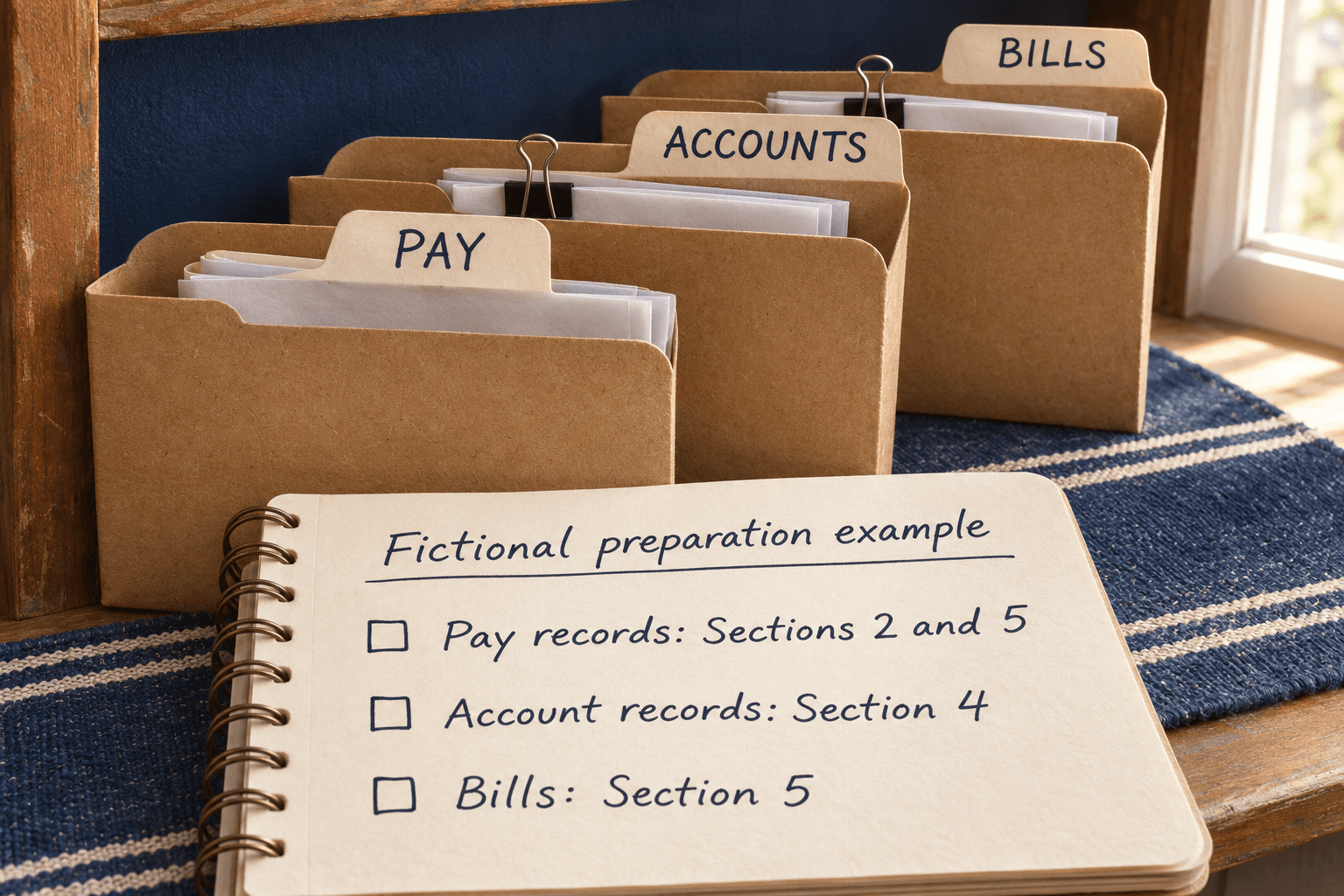
Fictional preparation example: group records by the sections they support before entering figures.
Start with Section 1's identity and household information. For each listed household member or dependent, distinguish whether you claimed that person on Form 1040 from whether that person contributes income. In Section 2, enter the taxpayer's and spouse's employment details where applicable, including the actual pay period. Form 433-A, page 1.
Read Section 3 through its continuation on page 2. It covers more than income changes: it also asks about legal and other financial circumstances, including lawsuits, bankruptcy, trusts, safe deposit boxes and certain asset transfers. Follow each question's conditions and provide its requested details after a Yes answer. Do not substitute a general statement that you have no extra income. Form 433-A, pages 1 and 2.
A fictional household to keep the figures straight
Alex and Morgan are fictional married wage earners with one child. They share expenses and have no self-employment income. Alex receives 600 gross twice each month. Their checking account holds 250 as of October 31, 2026.
Keep those figures separate: pay statements support monthly income, while bank statements support dated account balances. A deposit total is not a replacement for gross wages. The examples below show selected entries, not a completed statement or an IRS payment recommendation.
Income and living expenses
Section 5 is on page 6. Report amounts in U.S. dollars and use gross monthly wages, before withholding and payroll deductions. For wages paid weekly, the form says to multiply by 4.3; for wages paid every two weeks, multiply by 2.17; for wages paid twice each month, multiply by 2. Form 433-A, page 6, footnote 1.
For Alex and Morgan, the selected income entries are:
| Current-form field | Fictional calculation | Monthly entry |
|---|---|---|
| Line 21, taxpayer wages | $2,000 every two weeks × 2.17 | $4,340 |
| Line 22, spouse wages | $600 twice each month × 2 | $1,200 |
| Line 35, total income | 1,200, assuming no other income | $5,540 |
The distinction between every two weeks and twice a month matters. Do not apply the same multiplier to both pay schedules. Include other income in its designated field instead of treating the wage total as the household total. Form 433-A, page 6.
If you have self-employment income, complete Sections 6 and 7 first. Section 7 asks you to use a prior 3-, 6-, 9- or 12-month period to determine typical business income and expenses, and to identify that period. Its entries should reconcile with the business profit-and-loss statement. The current form transfers line 90's net business income to line 24 in Section 5; if the business result is a loss, enter zero on line 24. Follow the form's adjustments if using Schedule C, including adding back depreciation and depletion and removing duplicate deductions. Form 433-A, pages 6 and 8.
Report expenses without treating them as approved allowances
The current form separates your actual monthly expenses from an allowable-expense column reserved for the IRS. Enter your figures in the actual-expense column and leave the IRS column alone. For example, housing includes more than rent or mortgage payments; page 6's footnote includes utilities and other specified housing costs. Vehicle loan or lease payments belong in the ownership category, while fuel, insurance and maintenance belong in operating costs. Avoid counting the same payment twice. Form 433-A, page 6.
Alex and Morgan's fictional records support these selected actual expenses:
| Current-form line | Fictional actual monthly amount |
|---|---|
| 36, food, clothing and miscellaneous | $900 |
| 37, housing and utilities, including 250 utilities | $1,850 |
| 38, vehicle ownership costs | $275 |
| 39, vehicle operating costs | $300 |
| 41, health insurance | $210 |
| 42, out-of-pocket health care | $40 |
| 44, child/dependent care | $420 |
| 46, current-year taxes | $650 |
| 50, total living expenses, assuming no other expenses | $4,645 |
| 51, net difference: 4,645 | $895 |
These are invented reporting figures, not IRS standards or approved deductions. The $895 arithmetic result does not establish what the IRS will accept as a payment.
The IRS applies Collection Financial Standards when assessing ability to pay. National standards cover categories such as food and clothing; local standards cover housing and transportation. In most cases, local allowances use actual spending or the applicable standard, whichever is lower. The IRS can allow actual expenses when documented circumstances show the standards would not cover basic living needs. Use the current standards rather than copying someone else's dollar allowance.
Some expenses, including voluntary retirement contributions and unsecured debt payments, are not generally allowed, but the form preserves an exception when they are proven necessary for family health and welfare or producing income. Do not assume that listing an expense guarantees its allowance, or that a generally excluded expense has no possible exception. Form 433-A, page 6, footnote 6.
If only one spouse owes the tax but both have income, Publication 1854 says to list household income and expenses when you share expenses or live in a community property state. If you do not live in a community property state and do not share expenses, it says to list only the liable taxpayer's income and expenses. That is an OR condition for household reporting, not a requirement to meet both tests. Publication 1854, page 1.
Assets and accuracy
Section 4 covers personal assets in the United States and abroad. Work through each category instead of listing only the money you think is available to pay tax. Form 433-A, pages 2 through 5.
| Current-form location | What to check against your records |
|---|---|
| Line 12 | Cash held outside a bank. |
| Lines 13a through 13e | Personal bank accounts, including online/mobile accounts and stored-value cards, with balances and dates. Publication 1854 says to include accounts even if the balance is zero. |
| Line 14 | Investments, retirement assets and financial interests in businesses, with values and applicable loans. |
| Line 15 | Digital assets, their location, dated value and the other information the form requests. |
| Line 16 | Lines of credit and bank-issued credit cards, including amounts owed and available credit. |
| Line 17 | Life insurance policies with cash value and associated policy loans. |
| Line 18 | Real property interests, title holders, value, loans and payment details. |
| Line 19 | Purchased and leased vehicles, including the requested identification and financing details. |
| Line 20 | Other personal assets, including collections and intangible assets covered by the form. |
Field references above follow Form 433-A, June 2026. The zero-balance account instruction comes from Publication 1854, page 1. The publication's older line numbering should not be used to locate assets on this revision.
In the fictional example, Alex and Morgan list their 250 savings balance separately in Section 4, with October 31, 2026 as the balance date, then total 1,500 as wages.
Suppose they also own a car with a supported estimated current market value of 7,000. The equity calculation in the vehicle row is 7,000, or 275 monthly loan payment is a separate figure; it is neither the loan balance nor the equity. The form asks for each of those amounts. Form 433-A, pages 2 and 4.
Keep the valuation source and date with your records. If a value is an estimate, identify it as such in an attachment and explain the basis rather than presenting a guess as an exact balance. This is a preparation practice to make your figure traceable, not a substitute for requested verification. Publication 1854 describes current fair market value as what an asset could sell for today. Publication 1854, page 1.
Review before submitting
Compare the statement with the source records, then check the downloaded copy as well as the editor view. A complete-looking page can still contain the wrong pay multiplier, a missing account or an unsupported estimate.
- Confirm the requested form and revision. Check that you used regular Form 433-A rather than 433-F or 433-A (OIC).
- Check every required section, including continuation pages, conditional questions and attachments. Use N/A where applicable rather than leaving unanswered questions.
- Reconcile income to gross pay and the correct frequency. Recheck the business-to-household transfer if you have business income.
- Check dated account balances, current loan balances and asset valuations against their sources. Recalculate totals and avoid counting the same expense twice.
- Read the certification before signing. In the June 2026 form, the taxpayer signature, spouse signature and date are on page 6. Publication 1854 requires both spouses to sign for joint income tax liabilities.
- Follow the delivery and supporting-document instructions in your IRS request. If the destination or accepted signature method is unclear, confirm it with the IRS contact handling the request before sending.
The section, calculation and certification checks come from the current Form 433-A; the joint-liability signature rule is in Publication 1854. The form's certification is under penalties of perjury. Resolve unsupported figures before signing.
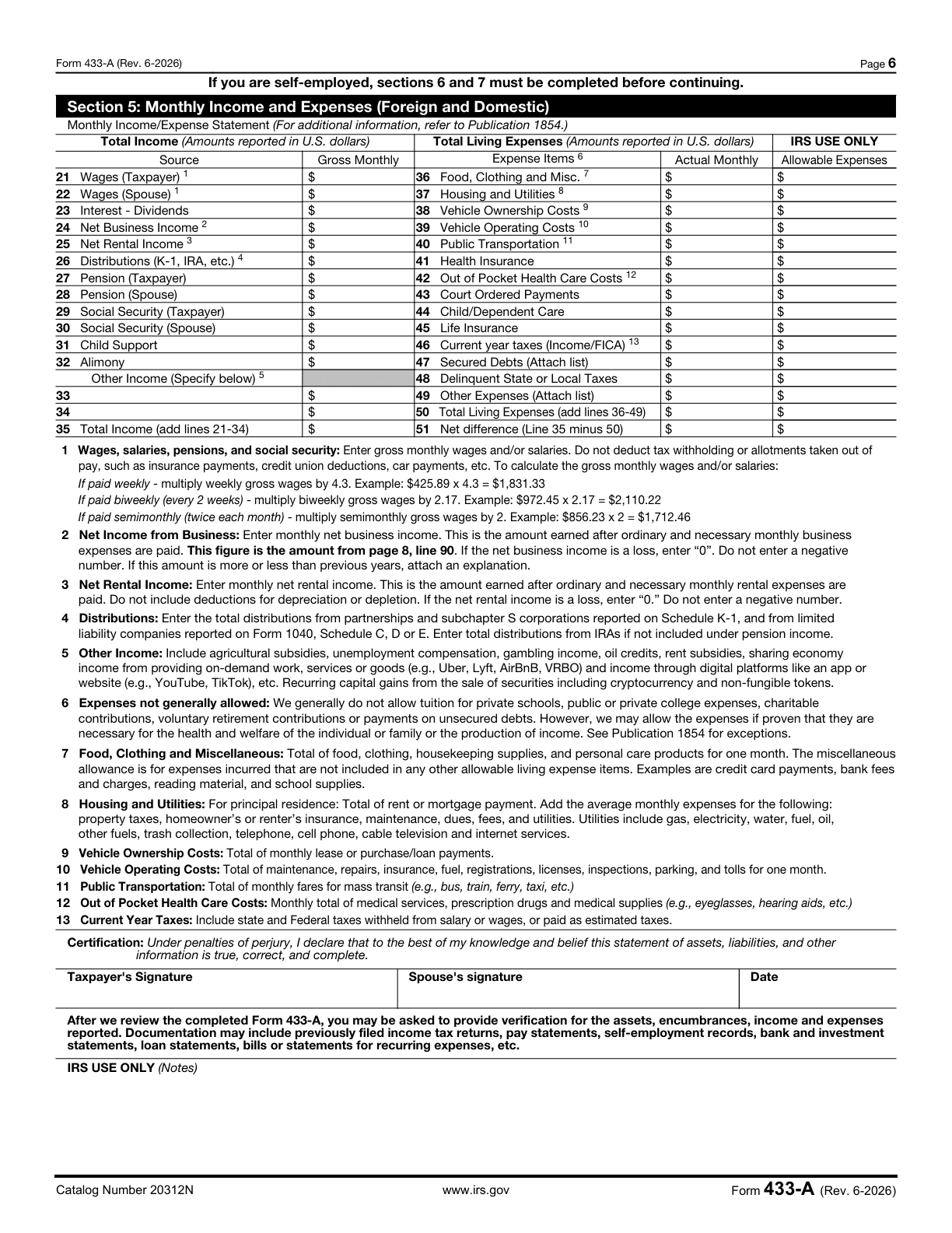
Official IRS Form 433-A, June 2026 revision, page 6. Compare your entries with the correct columns and read the certification before signing. The fictional amounts in this guide are not entered on this image. Open the official PDF.
Complete and review the PDF in Fylune
Download the official IRS PDF, then open it through Fylune's PDF editor. Enter your own facts in supported fields, review every answer, and add your own supported visible signature only when it fits the IRS's accepted process. Download or print the result, reopen the exported PDF, and inspect each page for missing text, clipped entries and missing attachments. The public editor supports PDF fields, text and visible signatures; it does not establish that a particular signature method is acceptable to the IRS.
AI assistance is available only where supported and uses facts you supply. It does not sign for you, certify identity or submit forms. Fylune does not file with the IRS or guarantee a collection outcome. The IRS determines its accepted submission process.
Fylune is a document editor for web and desktop. Web editing automatically saves account-owned cloud snapshots; desktop files stay local unless you turn on optional encrypted sync. Core editing is free. Free PDF exports include a watermark, and clean exports have paid options. Choose the workflow and export option that fit the document you need to deliver. Fylune PDF editor, current pricing.
Open the official PDF in the Fylune document editor, enter your own facts, and review every field before you download or print.
Official sources
- Form 433-A, Collection Information Statement for Wage Earners and Self-Employed Individuals, June 2026: current sections, fields, calculation footnotes and certification.
- Publication 1854, How to Prepare a Collection Information Statement, June 2026: preparation guidance, household-reporting conditions and joint-liability signatures. Some item and page references differ from the current form.
- Form 433-F, July 2024: the separate statement and its instructions.
- Form 433-A (OIC), April 2026: the version used with Form 656.
- IRS Collection Financial Standards: allowance categories and documented exceptions.
About the author: Orion Wells is Founder of Aurcue. Founder of StarSeekAI, writing about AI products, personal style systems, and the decisions behind useful photo-based guidance.