


By Nina@Aurcue, Chief Marketing Officer at Aurcue, writing as the Fylune marketing editor. Fylune is not affiliated with the California DMV and does not file forms or sign on your behalf. This guide explains the form; it is not legal or tax advice.
When you sell, buy, or gift a car, truck, motorcycle, or boat in California, a bill of sale is the one-page record that documents the handoff. The California DMV version is REG 135, officially titled the Vehicle/Vessel Bill of Sale. It records who transferred what, to whom, on what date, and for how much (or, for a gift, the relationship and the gift value). This guide walks through the reg 135 form field by field, for both the seller and the buyer, covers how a gift differs from a sale, and shows how to produce a clean, signed copy to keep.
The current edition is REG 135 (REV. 2/2007). Everything below is based on that official form, which you can read in full in the image further down.
What REG 135 is
REG 135 is the California DMV's vehicle/vessel bill of sale. In plain terms, it is a short declaration in which the seller states that they sold, transferred, and delivered a specific vehicle or vessel to a specific buyer. People often search for a "california dmv bill of sale" without knowing the form number; in California, that document is REG 135.
Two details make this form different from a generic bill of sale:
- It is a signed declaration. The seller signs under penalty of perjury that the information is true and correct.
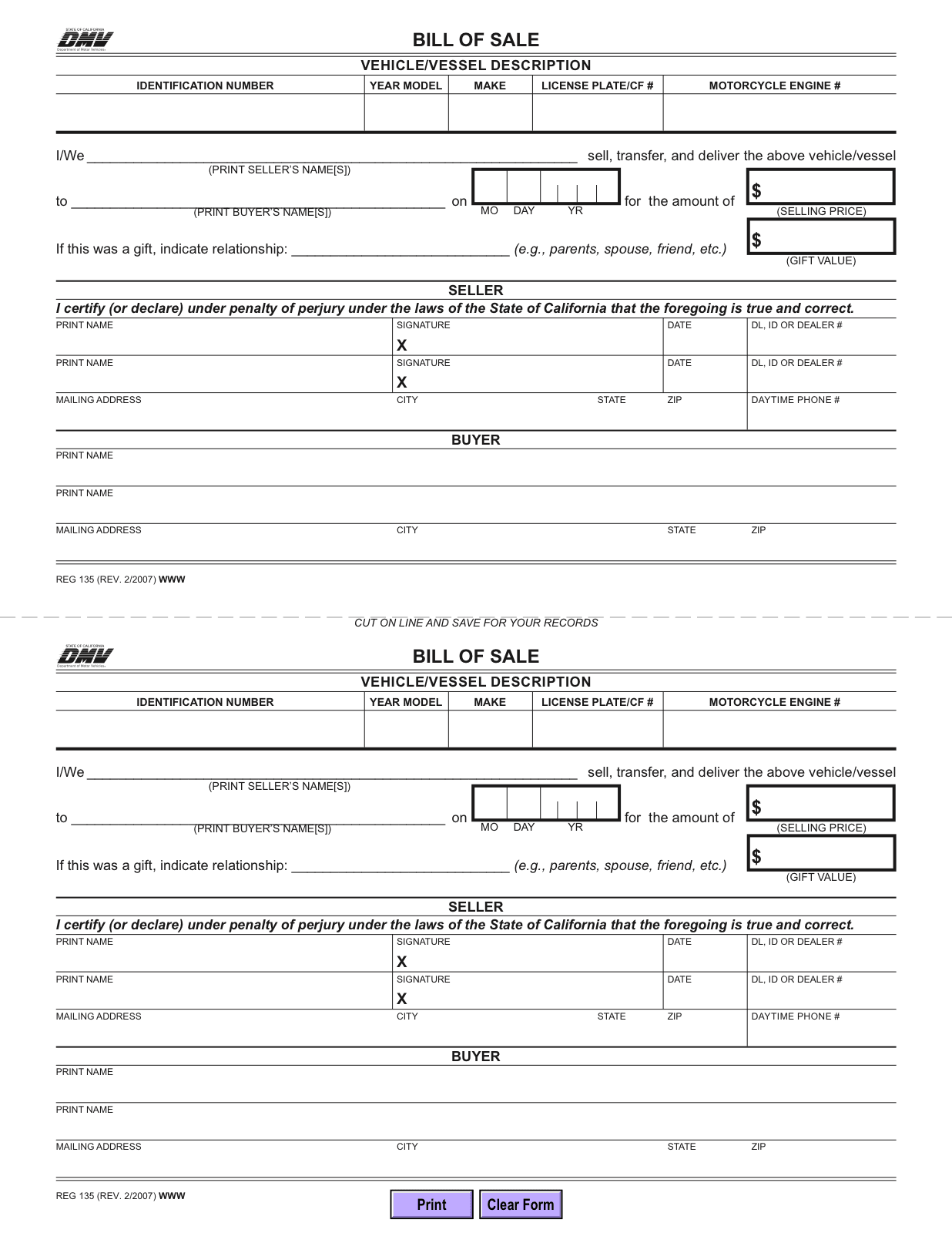
- It comes as two matching copies on one page. The top half is the transaction copy. Below a dashed line marked "cut on line and save for your records" is an identical records copy. You fill both, then keep the records copy for your files.
A bill of sale helps document the chain of ownership for a transaction. It is not a certificate of title and does not replace a title transfer. Requirements vary by transaction, so check the current official California DMV vehicle registration procedures and your DMV checklist rather than assuming every transfer needs the same paperwork.
Information to gather before you start
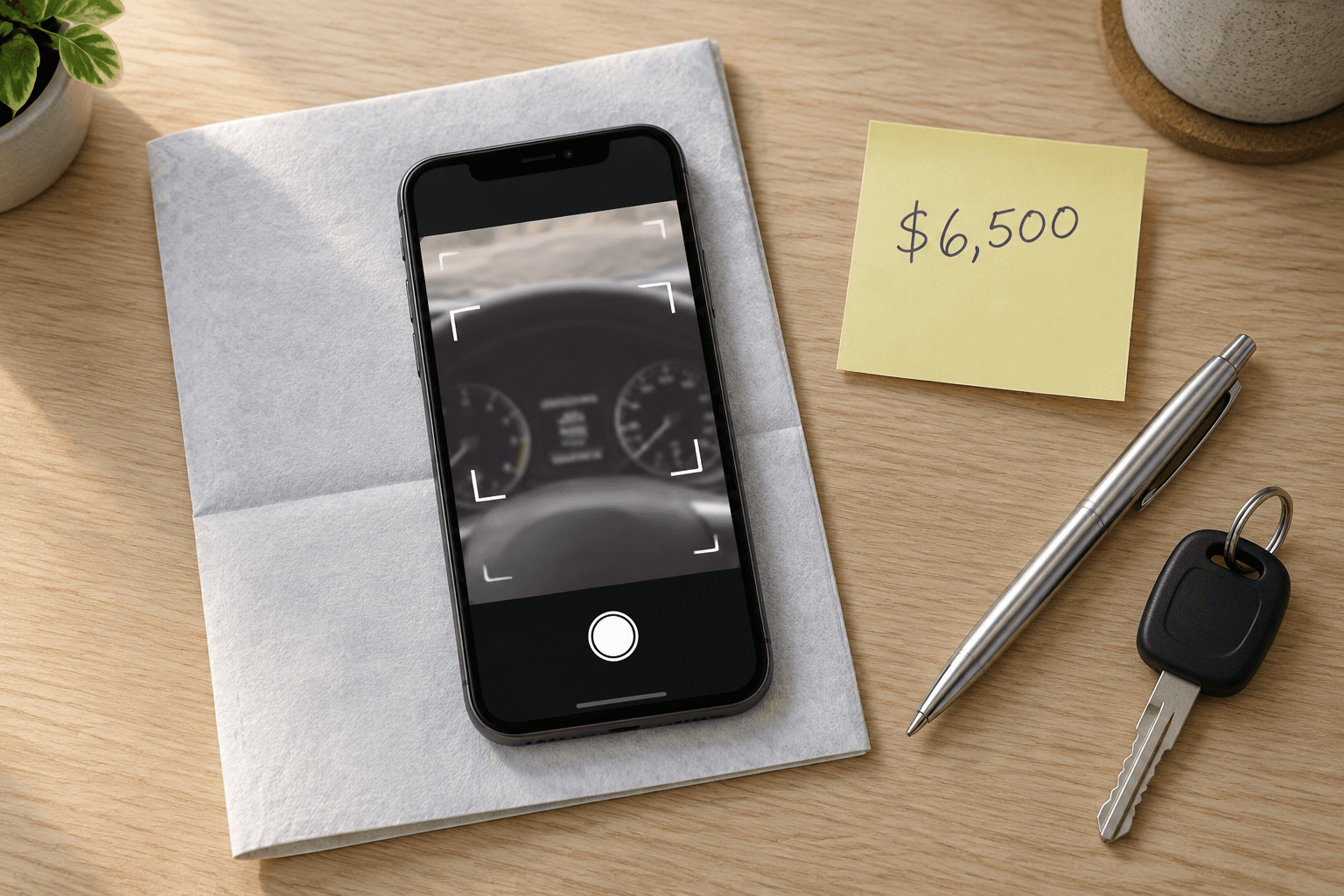
Filling the form goes quickly once you have the details in front of you. Collect:
- The vehicle or vessel identifiers: the identification number (the VIN for a vehicle or the HIN for a vessel), the year model, the make, and the license plate number (or the CF number for a vessel). For a motorcycle, you may also need the engine number.
- The transaction details: the date of sale and the selling price. If the transfer is a gift, you need the relationship between the parties and the gift value instead of a price.
- Both parties' details: the full legal names, mailing addresses, and the seller's driver license, ID, or dealer number. A daytime phone number is requested for the seller.
A quick photo of the title and the VIN plate, plus a note of the agreed amount, is usually enough to complete every field in one sitting.
REG 135 field by field
Below is the official REG 135 form. Notice that the whole layout repeats below the cut line: the transaction copy on top and the records copy underneath are identical, which is why your entries need to match on both.
Vehicle/vessel description
The band across the top captures what is being transferred:
- Identification number: the VIN for a vehicle or the HIN for a vessel.
- Year model: the model year.
- Make: the manufacturer.
- License plate/CF #: the plate number for a vehicle or the CF number for a vessel.
- Motorcycle engine #: complete this only for a motorcycle.
Transaction: date and amount
The sentence in the middle reads, "I/We [print seller's name(s)] sell, transfer, and deliver the above vehicle/vessel to [print buyer's name(s)] on [MO DAY YR] for the amount of $[selling price]."
- Print the seller's name(s) and the buyer's name(s) exactly as they appear on their identification.
- Enter the date of the transaction in the month, day, and year boxes.
- Enter the agreed selling price in the dollar field.
Gift designation and relationship (when it applies)
The next line reads, "If this was a gift, indicate relationship: __ (e.g., parents, spouse, friend, etc.)," followed by a separate gift value dollar field. Use this line only when the transfer is a gift rather than a sale. Leave the selling price blank in that case, and record the relationship and the gift value here instead. More on why this matters in the next section.
Seller details
Directly above the seller lines is the declaration: "I certify (or declare) under penalty of perjury under the laws of the State of California that the foregoing is true and correct." The seller block then provides:
- Two rows, each with print name, signature (marked with an X), date, and DL, ID or dealer #. The second row is for a co-owner or second seller.
- A final line for the seller's mailing address, city, state, zip, and daytime phone #.
The signature lines belong to the seller. The seller, not an assistant or a software tool, signs this declaration.
Buyer details
The buyer block is shorter than the seller block. It provides:
- Two print name rows (the second for a co-buyer).
- A line for the buyer's mailing address, city, state, and zip.
Note that the buyer block captures the buyer's name and address but does not include its own signature line. If you expected the buyer to sign the form, that is a common misreading: on REG 135, the declaration and signatures are on the seller side.
The duplicate records copy
Everything above repeats below the dashed "cut on line and save for your records" divider. Fill the records copy with the same information, so the copy you keep matches the copy that travels with the transaction.
Gift vs sale: what changes
The form deliberately separates a selling price from a gift. If money changed hands, fill in the selling price and leave the gift fields blank. If the vehicle or vessel was a gift, leave the selling price blank, write the relationship (for example, parents, spouse, or friend), and enter the gift value.
Why does this distinction matter? Whether a transfer is a sale or a gift can affect how use tax is treated when ownership is recorded, which is why the DMV asks you to be specific. How tax applies to your particular transfer is a question for the agency, not for a form guide, so follow the current official DMV instructions and any guidance they point you to. The job here is accuracy: describe the transfer as it actually happened, and keep the sale and gift fields from contradicting each other.
Common mistakes to avoid
Most problems with a bill of sale are small and easy to prevent:
- Copies that do not match. The records copy and the transaction copy must carry the same details. Fill both, then compare them before you separate them.
- A missing or wrong VIN/HIN or CF number. The identifiers tie the document to the exact vehicle or vessel. Copy them from the title or the item itself, not from memory.
- An incomplete date. Use the month, day, and year boxes carefully; a single-digit entry in the wrong box is a frequent slip.
- Confusing selling price with gift value. Pick one path, sale or gift, and fill only the matching fields.
- Unsigned seller lines. The seller's signature is what makes the declaration count. A blank signature line leaves the form incomplete.
- Forgetting the records copy. The whole point of the lower half is that you keep it. Do not hand over both halves.
Fill REG 135 and keep a clean copy in Fylune
You can fill REG 135 on paper or in the free official PDF. If you would rather type it, open the REG 135 template in Fylune and work directly in the official PDF. A few things make this path convenient for this particular form:
- Enter the details once; both copies update. Because REG 135 repeats below the cut line, Fylune carries your entries into both the transaction copy and the records copy, so they match by default. You still review both before printing.
- Optional AI help from Faye. On this form, Fylune's assistant, Faye, can ask about the sale or gift, the vehicle or vessel, and the parties, then fill the matching copies from the facts you provide, with corrections and undo. Faye does not invent transaction facts, assess taxes, sign for either party, or submit anything to an agency. You review every answer.
- Review, download, then sign. When the copies look right, download the PDF, print it, and complete the seller signatures by hand. Keep the records copy with your transaction documents.
Filling REG 135 manually in Fylune is free and does not require signing in, and the DMV's blank original is free as well. Clean PDF exports and AI credits are paid options; check the current pricing before relying on a paid feature. Fylune does not file the form with the DMV and does not sign for you. For adding a visible signature, review, and export to a supported PDF, see the Fylune free PDF editor.
FAQ
Is a California bill of sale the same as REG 135? Yes. REG 135 is the California DMV's vehicle/vessel bill of sale. When people search for a California DMV bill of sale, this is the form they mean.
Do I need both copies? The form includes a records copy below the cut line. Fill it to match the transaction copy and keep it for your own files.
Does Fylune file the form with the DMV? No. You download or print REG 135, sign it yourself, and keep or submit it according to the current DMV instructions. Fylune helps you complete and review the form; it does not file forms or sign for you.
Does the buyer sign REG 135? The signature lines on REG 135 are in the seller block, where the seller declares the information is true under penalty of perjury. The buyer block records the buyer's name and address.
Sources
- Official form: California DMV, Bill of Sale (REG 135, REV. 2/2007), dmv.ca.gov REG 135 PDF (read 2026-10-31).
- California DMV, Vehicle Industry Registration Procedures handbook, dmv.ca.gov (read 2026-10-31).
- Fylune REG 135 template, fylune.com/tools/forms/ca-reg-135 (read 2026-10-31).
<script type="application/ld+json">
{ "@context": "https://schema.org", "@graph": [ { "@type": "Article", "headline": "How to Fill Out REG 135: The California DMV Vehicle/Vessel Bill of Sale", "description": "Fill California DMV REG 135, the vehicle/vessel bill of sale, field by field for both buyer and seller, including the gift case and the records copy.", "mainEntityOfPage": "https://www.fylune.com/blog/how-to-fill-out-reg-135-california-dmv-bill-of-sale", "author": { "@type": "Person", "name": "Nina@Aurcue", "jobTitle": "Chief Marketing Officer at Aurcue", "url": "https://www.tiktok.com/@NinaAurcue" }, "publisher": { "@type": "Organization", "name": "Fylune", "url": "https://www.fylune.com" }, "datePublished": "2026-11-01", "image": "https://www.fylune.com/blog/how-to-fill-out-reg-135-california-dmv-bill-of-sale/assets/hero-vehicle-handover.png" }, { "@type": "HowTo", "name": "How to fill out California DMV REG 135 (Vehicle/Vessel Bill of Sale)", "step": [ { "@type": "HowToStep", "name": "Describe the vehicle or vessel", "text": "Enter the identification number (VIN or HIN), year model, make, license plate or CF number, and motorcycle engine number if applicable." }, { "@type": "HowToStep", "name": "Enter the transaction", "text": "Print the seller and buyer names, the date of transfer, and the selling price. For a gift, record the relationship and gift value instead of a price." }, { "@type": "HowToStep", "name": "Complete the seller block", "text": "Fill the seller's print name, driver license or ID or dealer number, mailing address, and daytime phone, then sign under penalty of perjury." }, { "@type": "HowToStep", "name": "Complete the buyer block", "text": "Enter the buyer's print name and mailing address." }, { "@type": "HowToStep", "name": "Match and keep both copies", "text": "Fill the records copy below the cut line to match the transaction copy, review both, then print, sign, and keep the records copy." } ] }, { "@type": "FAQPage", "mainEntity": [ { "@type": "Question", "name": "Is a California bill of sale the same as REG 135?", "acceptedAnswer": { "@type": "Answer", "text": "Yes. REG 135 is the California DMV's vehicle/vessel bill of sale. When people search for a California DMV bill of sale, this is the form they mean." } }, { "@type": "Question", "name": "Do I need both copies of REG 135?", "acceptedAnswer": { "@type": "Answer", "text": "The form includes a records copy below the cut line. Fill it to match the transaction copy and keep it for your own files." } }, { "@type": "Question", "name": "Does Fylune file REG 135 with the DMV?", "acceptedAnswer": { "@type": "Answer", "text": "No. You download or print REG 135, sign it yourself, and keep or submit it according to the current DMV instructions. Fylune helps you complete and review the form; it does not file forms or sign for you." } }, { "@type": "Question", "name": "Does the buyer sign REG 135?", "acceptedAnswer": { "@type": "Answer", "text": "The signature lines on REG 135 are in the seller block, where the seller declares the information is true under penalty of perjury. The buyer block records the buyer's name and address." } } ] } ] }
</script>