

By Orion Wells
A useful REG 166 preparation copy keeps the vehicle's registered owner separate from the lienholder releasing its interest. Gather the vehicle and owner records, ask the lender to confirm its details and release authority, and leave the actual signature, execution date and notary block for the appropriate people. Paying off the loan does not make the registered owner the lender's authorized signer.
This worked example follows California DMV's REG 166 form, revision 12/2016, checked November 11, 2026. It produces a preparation worksheet and handoff checklist, not an executed release or a finding that DMV will accept your transaction.
AI-generated editorial illustration of the preparation handoff. No completed form or signing procedure is depicted.
Check the title route before filling
The instructions at the top of the official DMV REG 166 PDF exclude vehicles with paperless titles and vehicles two model years or newer. For the latter, the legal owner's interest can only be released using a Certificate of Title. Check both the title type and model year before entering details.
Our fictional case uses a 2018 vehicle with a paper title. The year alone does not establish eligibility: a real preparer must confirm the actual title route. If either exclusion applies, stop this exercise and check the applicable process with DMV and the lienholder.
Gather the correct parties and records
Keep two sets of information beside the form:
- Vehicle and registered-owner records: plate or CF number, make/builder, year model, vehicle identification number, and the owner's name as it appears on the title, registration or contract.
- Lienholder-confirmed information: legal-owner name, business or residence address, any different mailing address, authorized agent's name and title, and contact information. The lender must also verify the certification it will sign.
Section 3 certifies both full satisfaction of the lien and that it has not been assigned to another party. Treat these as two separate checks. A payoff receipt belongs in the supporting records; it is not, by itself, the legal owner's executed release.
Work through sections 1-3 with a fictional preparation table
Every identity and value below is fictional. PLATE-EXAMPLE and VIN-EXAMPLE-ONLY are deliberately invalid teaching placeholders. Address A and address B are labels, not usable postal addresses. Never copy these values into a real filing.
Alex Chen is the registered owner. EXAMPLE Lender A is the legal owner of record. In this exercise, the lender's records confirm full satisfaction and no assignment. Jordan Lee is an EXAMPLE agent whose authority and job title still require the lender's confirmation. No execution date or signature is supplied.
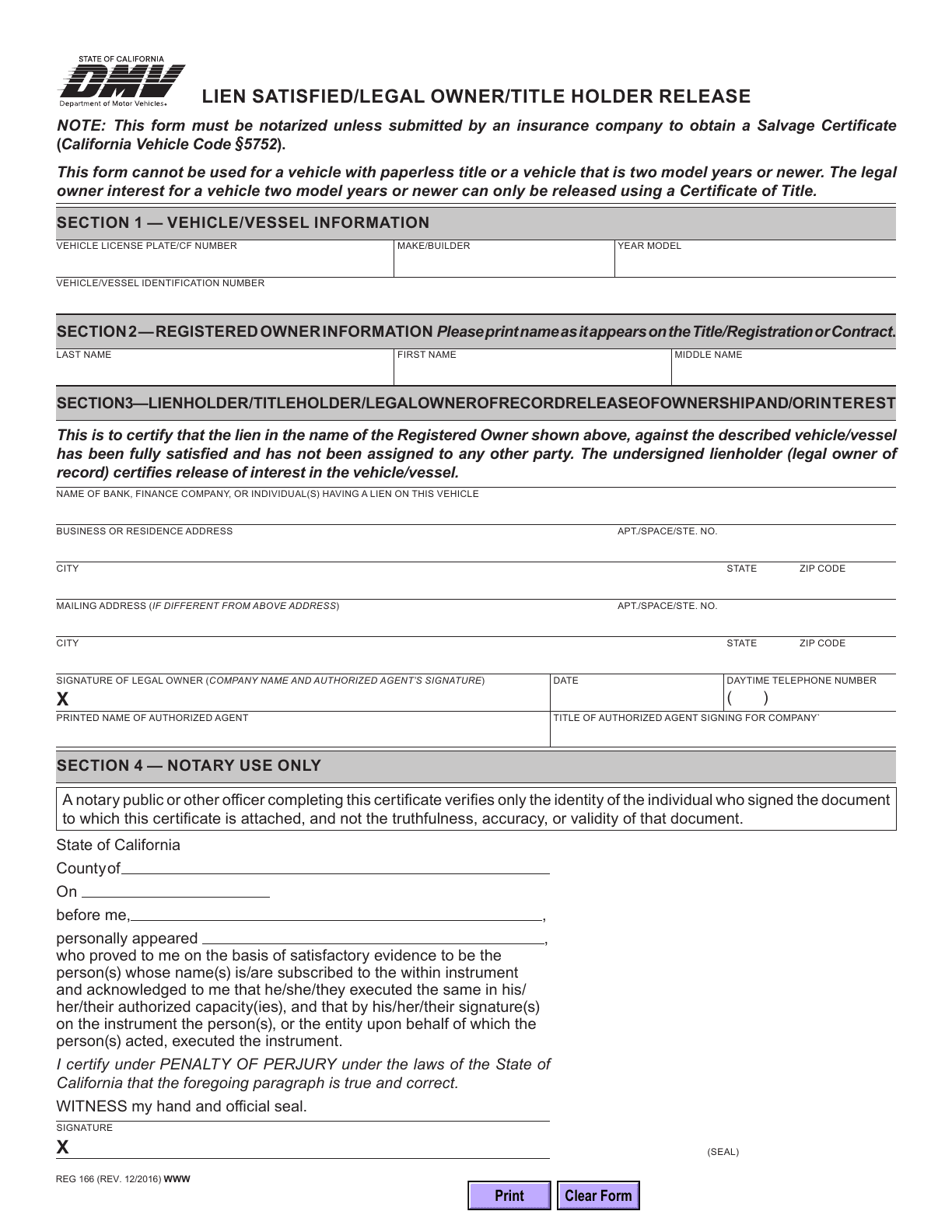
Current first-page preview from Fylune's REG 166 template page, reproduced without fictional entries or altered fields. Open the official full-size DMV PDF.
Use the official form's section labels and fields to trace each fact:
| Fictional source fact | Actual form destination | Who confirms it | Preparation-copy review |
|---|---|---|---|
Plate PLATE-EXAMPLE; make Example Motors; model year 2018; VIN-EXAMPLE-ONLY | Section 1: plate/CF number, make/builder, year model and vehicle/vessel identification number | Preparer compares actual vehicle records in real use | Check every character. Missing identifiers remain questions, never AI guesses. |
| Alex Chen, EXAMPLE registered owner | Section 2: last, first and middle-name fields, following the record | Registered owner checks the title, registration or contract | For this example, Chen is last name and Alex is first name. No middle name is supplied; resolve the real record rather than guessing. |
| EXAMPLE Lender A | Section 3: name of the bank, finance company or individual having the lien | Lender | Do not substitute Alex's name. |
| EXAMPLE business address A; separate EXAMPLE mailing address B | Section 3: business/residence address and mailing address if different, including their unit, city, state and ZIP fields | Lender | Keep A and B distinct. Both groups describe the lienholder. Obtain complete real addresses before execution. |
| Jordan Lee, EXAMPLE proposed agent; title not supplied | Section 3: printed authorized-agent name and title | Lender checks authority and supplies the actual title | A typed name or job title is not proof of signing authority. |
| Full satisfaction and no assignment confirmed in this fictional fact set | Section 3 certification | Legal owner or its authorized agent | Check both statements against actual lender records before signing. |
| No simulated execution or invented contact details | Section 3: legal-owner signature, date and daytime telephone | Authorized signer supplies the real execution details and contact | Leave signature and date unexecuted in this preparation copy. Obtain the real contact number from the lender. |
| No notarial facts supplied | Section 4: notary-use-only block | Notary or appropriate officer | Preparer and AI leave the entire block untouched. |
Correct the owner's address copied into the lender section
Suppose Alex's own address was pasted into Section 3 because the preparer assumed every address on the page belonged to the vehicle owner. The worksheet should show the correction and its source:
| Deliberately wrong mapping | Reviewed correction | Evidence needed in real use |
|---|---|---|
| Alex's address in Section 3 business/residence address | EXAMPLE Lender A's business address A, with its corresponding unit, city, state and ZIP | Lender-confirmed business/residence details |
| Alex's address repeated as the different mailing address | EXAMPLE Lender A's separate mailing address B, with its corresponding unit, city, state and ZIP | Lender confirmation that its mailing address differs |
| Alex named as the legal-owner signer because Alex repaid the loan | Keep Alex in Section 2; leave the signature unexecuted for the legal owner or authorized company agent | Legal-owner record and lender confirmation of the actual agent's authority |
Trace each corrected entry to the lender's records. Ask whose address or authority the field describes before copying a value. Section 3 places these addresses and the release signature under the lienholder/legal-owner heading.
Open the CA-REG-166 template in Fylune with your own confirmed facts. The template page describes assistance for supported fields; review every proposed entry and keep unresolved facts outside the form until confirmed.
Stop at the legal-owner signature and notary block
REG 166's signature line calls for the legal owner's signature, including the company name and authorized agent's signature for a company. The neighboring printed-name and title fields identify the agent; they do not replace the signature. Alex should not sign that line simply because Alex is the registered owner.
The form requires notarization unless an insurance company submits it to obtain a Salvage Certificate. That exception has both conditions. It is not a general exemption for a paid-off loan. Arrange the actual execution and notarization procedure with the authorized signer and notary; this preparation example does not prescribe advance signing or remote notarization.
Leave Section 4 untouched. Its certificate states that the notary or other officer verifies the signer's identity, not the truthfulness, accuracy or validity of the attached document. Do not ask a preparer or AI assistant to invent the appearance date, officer's name, signer details, signature or seal. Read the certificate on the original form.
A visible signature mark in a PDF does not complete that notarial certificate. It also does not establish certificate-based digital signing: Adobe explains that a digital signature uses a certificate-based digital ID. Neither a typed name nor a downloaded file establishes that the required people have completed the release.
Use this responsibility checklist with the actual people handling the document:
| Preparer / registered owner | Legal owner / authorized company agent | Notary or appropriate officer |
|---|---|---|
| Compare Section 1 identifiers and Section 2 name with source records. | Confirm the Section 3 legal-owner name and both address groups. | Handle the notarial certificate under the applicable procedure. |
| Flag missing information and remove example placeholders. | Verify full satisfaction and no assignment; confirm who has authority to release the interest. | Complete Section 4's required details, signature and seal as appropriate. |
| Hand over an unexecuted preparation copy; leave Section 4 untouched. | Review the legal-owner signature line, real date and daytime phone; confirm the printed agent name and title. The authorized person handles execution. | Perform the officer's own checks; the preparer does not supply invented notarial facts. |
Review the downloaded preparation copy
Fylune's PDF editor supports PDF fields, text, visible signatures, review and export. For this exercise, the useful output is an unexecuted preparation copy to compare with the source-fact worksheet. Use the worksheet to review your own downloaded file before handing it to the authorized signer.
Reopen your actual download and check it against the records, not just the editor preview:
- Identifiers: compare the plate/CF number, make, year and VIN character by character. Remove every EXAMPLE placeholder from a real form.
- Names and roles: confirm the registered owner is in Section 2 and the actual lienholder is in Section 3. Do not turn a printed agent name into assumed authority.
- Two addresses: compare the lender's business/residence address with its different mailing address. Confirm that the owner's address has not returned to either group.
- Execution boundary: check that the preparation copy has no simulated signature or execution date and that Section 4 remains untouched. Give the authorized signer the unresolved contact, title or authority questions.
- Readable output: inspect all fields for clipped text, misplaced entries or missing content. Correct the source facts or entries and download again if needed.
For the fictional case, the worksheet review should end like this: Alex stays in Section 2; EXAMPLE Lender A and its A/B addresses stay in Section 3; Jordan's authority and title remain lender-confirmation items; the real signature, date and notary certificate remain unexecuted. A worksheet can be reviewed while the release itself is still incomplete.
Open the CA-REG-166 template in Fylune when you are ready to prepare your own review copy. Fylune does not submit the form, provide notarization or guarantee DMV acceptance. Check the other documents and requirements for your particular title transaction with DMV before sending an executed release.
Sources
- California DMV: REG 166, Lien Satisfied/Legal Owner/Title Holder Release. One-page original and printed instructions, revision 12/2016; checked November 11, 2026.
- Fylune: CA-REG-166 template and field guidance.
- Fylune: PDF editor capabilities.
- Adobe: Digital signatures overview.