

If your single-member LLC is a disregarded entity and you own it as a U.S. individual, both names belong on the form, in a fixed order. Line 1 carries your name as the owner. Line 2 carries the LLC's business name. On line 3a you check the current "Individual/sole proprietor" box, and in Part I you give your SSN or your own EIN, not the LLC's EIN.

That mapping comes from the form itself and from the IRS guidance for single-member LLCs. The W-9's line 1 instruction tells a sole proprietor or disregarded entity to "enter the owner's name on line 1, and enter the business/disregarded entity's name on line 2," and the IRS single-member LLC page states that when a disregarded LLC owned by an individual must provide a W-9, the form "should provide the owner's SSN or EIN, not the LLC's EIN." This article walks through each field for that exact case, shows a filled example, and flags the situations where the mapping changes.
First, confirm you are in the disregarded case
The IRS treats an LLC with only one member as an entity disregarded as separate from its owner for federal income tax purposes, unless the LLC files Form 8832 and elects to be treated as a corporation. In the disregarded case, the LLC's activities are reported on the owner's federal tax return, typically Schedule C, Schedule E, or Schedule F of Form 1040.
Two checks before you fill anything in:
- Number of members. One member points toward disregarded treatment, but membership alone does not settle it. If the LLC filed Form 8832 and elected corporate treatment, the W-9 follows that election instead.
- Owner type. This article covers an LLC owned by one U.S. individual. If a corporation, partnership, or foreign person owns the LLC, the mapping below does not apply to you; see the branch section near the end.
If both checks match your situation, the rest of this page gives you the field-by-field answer.
Line 1: your name, the owner's name
Line 1 asks for the name of the person or entity whose taxpayer identification number you are providing. In the disregarded single-member case, that person is you, the owner. The current form's line 1 label makes this explicit: for a sole proprietor or disregarded entity, the owner's name goes on line 1.
Use your name as it appears on your tax return. If you file as Jane A. Sample, that is the name that belongs on line 1, even if everyone knows the business by another name. The name/TIN combination the requester reports to the IRS keys off line 1 together with the TIN in Part I, so a nickname or the business name in that slot creates avoidable mismatch risk.
Line 2: the disregarded LLC's business name
Line 2 is for a business name, trade name, DBA name, or disregarded entity name that differs from line 1. This is where the LLC's registered name goes.
In the worked example below, the owner enters her own name on line 1 and her LLC on line 2:
| Field | Entry in the example |
|---|---|
| Line 1: Name | Jane A. Sample |
| Line 2: Business name/disregarded entity name | Sample Design LLC |
| Line 3a: Federal tax classification | Individual/sole proprietor |
| Part I: Taxpayer Identification Number | The owner's SSN or the owner's EIN |
Jane A. Sample and Sample Design LLC are fictional names used to illustrate the mapping; they are not a real taxpayer or business.

A practical consequence of this order: a client's accounts payable system often displays line 2 as the vendor name, which is why your LLC name still shows up correctly on invoices and payment records even though line 1 and Part I identify you personally.
Line 3a: check the box for the owner's classification
Line 3a asks for the federal tax classification of the person whose name is entered on line 1. In this example that person is you, an individual, so you check the "Individual/sole proprietor" box.
This label is worth checking against the form you are actually holding, because it changed. Before the March 2024 revision, the first checkbox read "Individual/sole proprietor or single-member LLC." The revised form shortened the label to "Individual/sole proprietor" and added a note that a disregarded entity should instead check the box for the tax classification of its owner. The result is the same for your case, but the reasoning is now explicit on the form: the box describes the owner, not the LLC.
Do not check the "Limited liability company" box. On the current form that box applies to an LLC taxed as a C corporation, an S corporation, or a partnership, and you enter the matching letter beside it. A disregarded single-member LLC does not select that box; it follows its owner's classification.
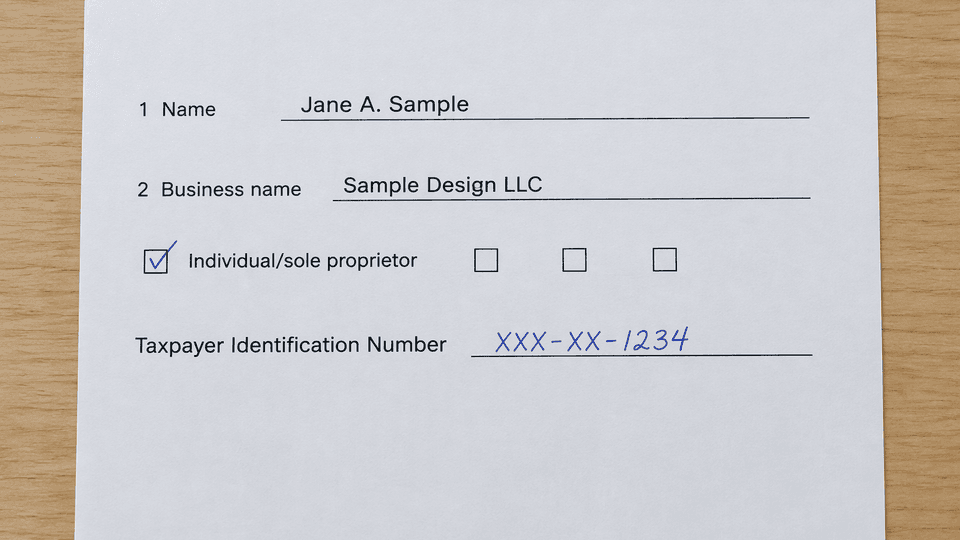
The worksheet above is a simplified fictional illustration of the field mapping, not the official IRS form layout; the current official form and its payee instructions are linked in the Sources list.
Part I: your SSN or your EIN, not the LLC's EIN
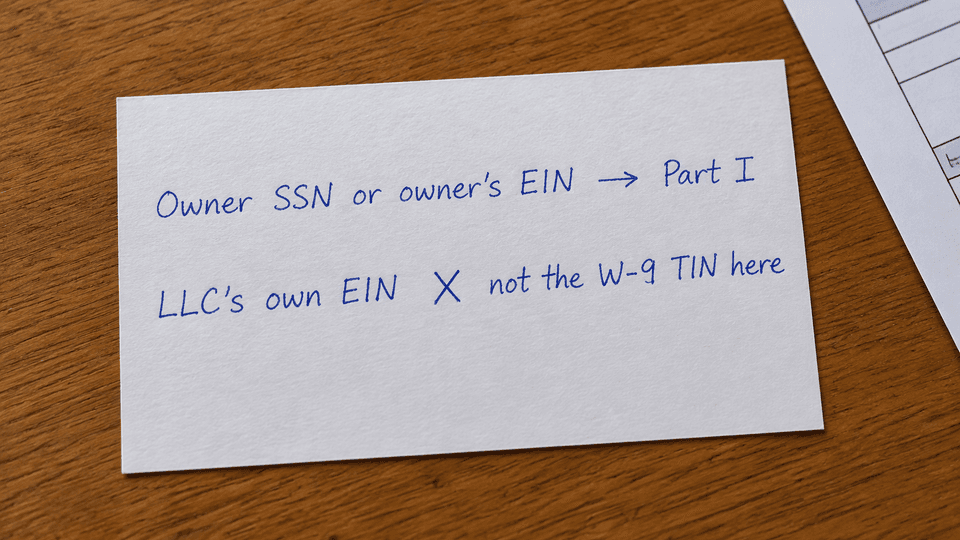
Part I is where many single-member LLC filings go wrong. The rule from the IRS is direct: for federal income tax purposes, a disregarded single-member LLC generally must use the owner's SSN or the owner's EIN on information returns and reporting related to income tax. When a disregarded LLC owned by an individual is asked for a W-9, the form should provide the owner's SSN or EIN, not the LLC's EIN. The card below shows that decision at a glance.
So where does the LLC's own EIN fit? The IRS treats a single-member disregarded LLC as a separate entity for employment tax and certain excise tax purposes. The LLC needs an EIN if it has employees or files excise tax forms, and many LLCs also obtain one for banking or state-law reasons. That EIN is real and useful, but it belongs to those employment and excise contexts, not to the income-tax W-9 in this example. An LLC that has no employees and no excise tax liability does not need an EIN at all, and in that case the owner's name and TIN carry all federal tax reporting.
Review lines 1 and Part I together before you sign. Line 1 names the owner, Part I gives the owner's number, and the two must describe the same person.
When your facts differ from this example
The mapping above is specific to one case: a disregarded single-member LLC owned by a U.S. individual. Three common variations change the answer:
- Corporate election. If your LLC filed Form 8832 and elected C or S corporation treatment, the W-9 follows the corporation's classification and TIN instead. Our guide How to fill out a W-9 for your LLC: which tax box? covers the classification-box decision, including corporate elections.
- Entity owner. If a corporation or partnership owns the single-member LLC, the IRS treats the LLC as a division of that owner for income tax purposes. The W-9 follows the entity owner's classification and TIN, not the individual example on this page.
- Foreign owner. If the owner is not a U.S. person, Form W-9 is generally the wrong form and the W-8 series may apply instead. Follow the applicable IRS instructions for foreign owners rather than copying this example.
None of these branches is rare, so confirm which one describes your LLC before you submit the form to a client.
Fill and export your single-member LLC's W-9 with Fylune
You can complete Form W-9 in the Fylune W-9 tool, entering the owner and LLC names, the classification box, and the TIN from the mapping above, then export a PDF ready to return to the requester.
Two boundaries worth stating plainly. Fylune is not affiliated with the IRS, does not submit forms to government agencies, and does not determine your tax classification. And before you return any W-9, review the certification and signing requirements that apply to your actual request, including the requester's instructions, because those requirements depend on facts this article cannot check for you. This page is general form guidance for the defined case above, not individualized tax advice.
For general line-by-line mechanics that apply to any W-9 request, see How to fill out a W-9 when a client asks for one; the single-member LLC specifics live on this page.
FAQ
Can I use my EIN instead of my SSN on the W-9?
Yes, if the EIN is yours as the owner. The IRS rule for this case allows the owner's SSN or the owner's EIN in Part I. It does not allow the LLC's own EIN for the income-tax W-9 described here.
Why is the LLC's own EIN different?
The LLC's EIN serves employment tax and certain excise tax purposes, where the IRS treats the single-member LLC as a separate entity even though it is disregarded for income tax. A W-9 supplied for income-tax reporting is different reporting, so it follows the owner's TIN.
Which mailing address should I use for the W-9?
The W-9 goes back to whoever requested it, such as your client or their accounts payable team. It is not filed with the IRS by the payee, so there is no IRS mailing address for your copy. Use the return instructions your requester gave you.
What if the client's system rejects the owner's name?
Some accounting systems match the name on line 1 against the TIN in Part I using IRS records. Keep line 1 as the owner's legal name as shown on the tax return, and put the LLC name on line 2 where the client's vendor records usually read it from. If a system insists that line 1 match the LLC name, ask the requester how they want a disregarded entity identified before overriding the IRS instruction.
Ready to complete the form? Open the Fylune W-9 tool and export a PDF with the owner and LLC names mapped as shown above.
Sources
- IRS, Form W-9 (Request for Taxpayer Identification Number and Certification), current revision, including line 1, line 2, line 3a, and payee Specific Instructions: https://www.irs.gov/pub/irs-pdf/fw9.pdf
- IRS, Single Member Limited Liability Companies, Taxpayer identification number section (owner SSN or EIN rule, employment and excise tax EIN context): https://www.irs.gov/businesses/small-businesses-self-employed/single-member-limited-liability-companies
- IRS, Limited Liability Company (LLC), classifications and Form 8832 election: https://www.irs.gov/businesses/small-businesses-self-employed/limited-liability-company-llc
- IRS, About Form W-9, purpose and current revision: https://www.irs.gov/forms-pubs/about-form-w-9
- Deloitte tax@hand, IRS releases final updated Form W-9 (March 2024 revision, line 3a label change and disregarded entity note): https://www.taxathand.com/article/34161/United-States/