


A wholesale customer, a marketplace or a bank has asked your LLC for a Form W-9, and line 3a offers seven boxes. "LLC" looks like the obvious choice. On the current form, it is the right choice for only some LLCs.
The short answer to how to fill out a W-9 for an LLC: the box follows how the IRS taxes the LLC, not the word "LLC" in its name.
Both answers assume a W-9 is the right form. The IRS says to use Form W-9 only if you are a U.S. person (including a resident alien). A foreign person uses the appropriate Form W-8 or Form 8233 instead, and so does the foreign owner of a disregarded LLC.
- If the LLC is a disregarded entity whose owner is a U.S. person (typically a single-member LLC with no corporate election), check the box for your owner's tax classification, not the LLC's own. For an individual owner, that box is Individual/sole proprietor. If the first owner that is not disregarded is itself an LLC taxed as a partnership or corporation, lines 1 and 3a describe that owner, so line 3a shows LLC with that owner's P, C or S.
- If the LLC is not disregarded and is itself a U.S. person, such as an LLC organized in the United States, check LLC and write P (partnership), C (C corporation) or S (S corporation) in the entry space.
That rule comes from the note under line 3a of Form W-9 (Rev. March 2024), the revision the IRS lists as current on its About Form W-9 page. This guide helps you work out which group your LLC is in, walks through a complete fictional example, and explains line 3b, which partnership-taxed LLCs can easily get wrong. If you are filling out the form for the first time, our guide to how to fill out a W-9 when a client asks for one covers every field line by line.
This is general form-filling guidance, not tax advice. Your LLC's classification has tax consequences beyond this form, so confirm it from your own records or with a tax professional. Fylune is not affiliated with the IRS.
Start with your confirmed federal tax classification
Your state creates the LLC, but the IRS decides how it is taxed. The IRS limited liability company page says that, depending on elections and the number of members, it treats an LLC as a corporation, a partnership, or part of the owner's tax return (a "disregarded entity").
For a domestic LLC, the IRS defaults are:
- Two or more members: classified as a partnership, unless the LLC files Form 8832 and elects to be treated as a corporation.
- One member: disregarded as separate from its owner for income tax purposes, unless the LLC files Form 8832 and elects to be treated as a corporation.
The W-9's own line 3a instructions also cover an LLC that has filed Form 2553 to be taxed as an S corporation.
Defaults are a starting point, not your answer. Before you check a box, confirm:
- Any election on file. Look in your records for a Form 8832 or Form 2553 filing and any related IRS correspondence. Note when it takes effect: the IRS says an 8832 classification election generally cannot take effect more than 75 days before it is filed or more than 12 months after.
- Where the income is reported. The W-9 instructions tie line 1 to the name on the income tax return that reports the income. If the LLC's income goes on the owner's return, that points to disregarded treatment.
- Special cases. The IRS notes special rules for foreign LLCs. If a disregarded LLC's owner is a foreign person, the owner uses a Form W-8 instead of a W-9.
- Payroll is a separate question. For employment tax and certain excise taxes, the IRS still treats a single-member LLC as a separate entity. An LLC can be separate for payroll purposes and still be disregarded on its W-9.
Quick decision table
Find the row that matches your confirmed treatment. The "typical context" column shows the domestic defaults and elections described above. It does not cover foreign LLCs or other special cases.
| Confirmed federal tax treatment | Typical context | Line 3a action | Line 1 name | Part I TIN |
|---|---|---|---|---|
| Disregarded, owned by an individual | One U.S.-person member, no corporate election | Individual/sole proprietor | Owner's name (LLC name on line 2) | Owner's SSN, or the owner's EIN if the owner has one. A resident-alien owner who does not have, and is not eligible to get, an SSN enters an ITIN in the SSN space |
| Disregarded, owned by an entity | One member that is itself not disregarded | The box for the owner's classification | The first owner that is not disregarded (LLC name on line 2) | The owner's EIN |
| Partnership | Two or more members, no corporate election | LLC, enter P | The LLC's name | The LLC's EIN |
| C corporation | Form 8832 corporate election in effect | LLC, enter C | The LLC's name | The LLC's EIN |
| S corporation | Form 2553 election in effect | LLC, enter S | The LLC's name | The LLC's EIN |
| Unsure, pending election, foreign owner or foreign LLC | Facts not settled by the rows above | Stop and check your records and the IRS instructions |
A note on the owner's TIN in the first row. Part I on page 1 of the form says that for a resident alien, sole proprietor or disregarded entity you should see the Part I instructions. Those instructions (page 4) say that a resident alien who does not have, and is not eligible to get, an SSN uses an IRS ITIN as the TIN and enters it in the Social security number space. If that owner has no ITIN yet, the form points to "How to get a TIN," which names Form W-7 as the ITIN application. The ITIN belongs to the individual owner. It is not a number for the LLC: for a disregarded single-member LLC, Part I always carries the owner's number. This does not open the W-9 to every non-citizen. The form says to use it only if you are a U.S. person (including a resident alien). A foreign person uses the appropriate Form W-8 or Form 8233, and if a disregarded LLC's owner is a foreign person, the owner completes a Form W-8 even if they have a U.S. TIN.
Read across each row, and the checked box always describes the taxpayer named on line 1. For a disregarded LLC, that taxpayer is the owner. For example, if a partnership-taxed LLC owns a single-member LLC, the partnership-taxed owner goes on line 1, and line 3a describes that owner (LLC, enter P).
Older copies of the form used different wording. The October 2018 revision labeled the first box "Individual/sole proprietor or single-member LLC." The March 2024 revision says only "Individual/sole proprietor," and the single-member rule now appears in the note under the LLC box. Some online summaries still repeat the old label, so check the revision printed in the top-left corner of your form. This guide follows the March 2024 revision.
Line 3a and line 3b in the current W-9
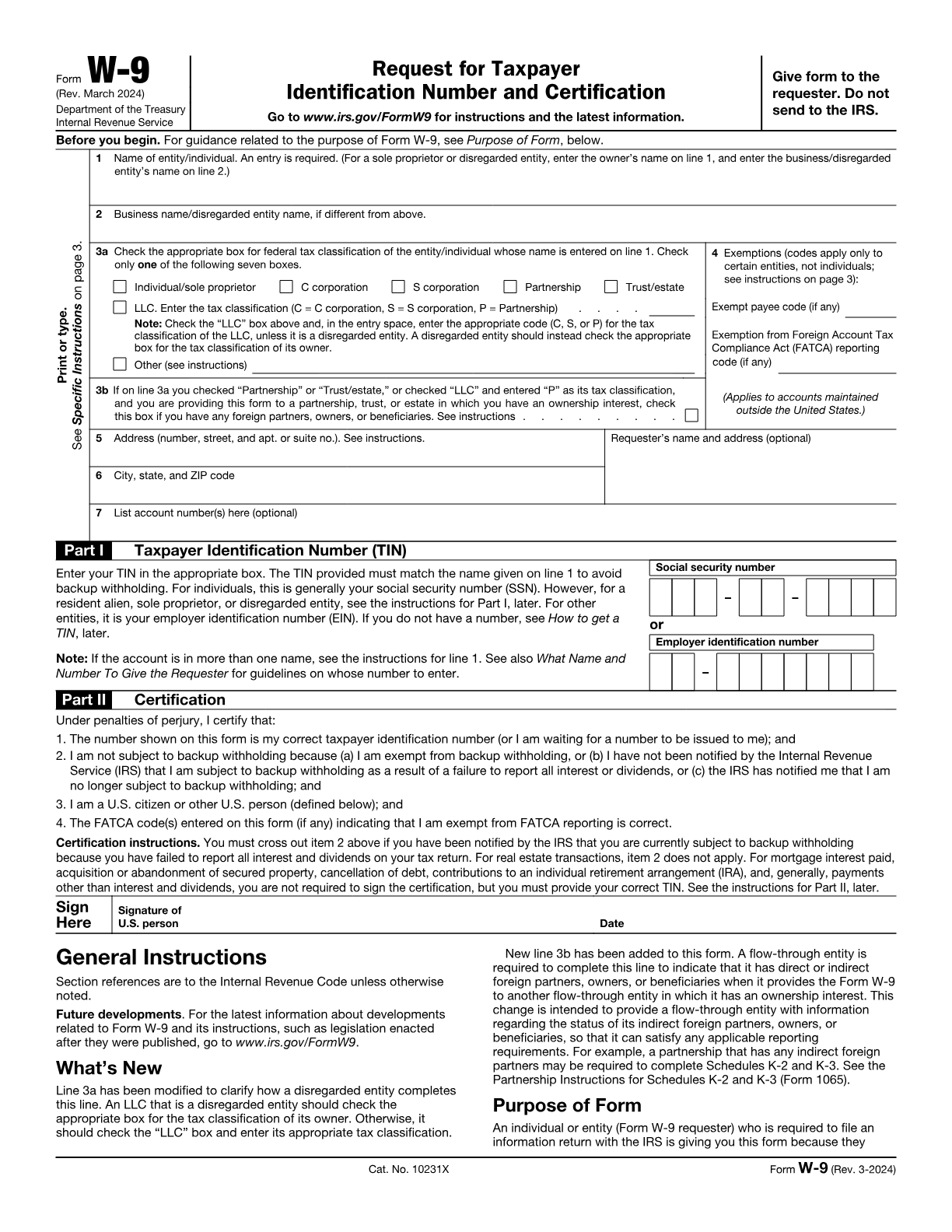
Page 1 of the official, unfilled Form W-9 (Rev. March 2024) from irs.gov. Line 3a's seven boxes and the line 3b checkbox sit below lines 1 and 2.
Line 3a: choose one classification
Line 3a asks for the federal tax classification of the entity or individual whose name is on line 1, and you check only one box. The seven printed options are Individual/sole proprietor, C corporation, S corporation, Partnership, Trust/estate, LLC (with an entry space for C, S or P), and Other (see instructions).
For an LLC, that means:
- One box only. A partnership-taxed LLC checks LLC and writes P. It does not also check the Partnership box.
- One letter in the entry space: C = C corporation, S = S corporation, P = Partnership.
- Disregarded LLC: check the box that describes the first owner that is not disregarded, not the disregarded LLC itself. That is usually not the LLC box. The exception is an owner that is itself an LLC classified as a partnership or corporation: then line 1 shows that owner, and line 3a shows LLC with the owner's P, C or S.
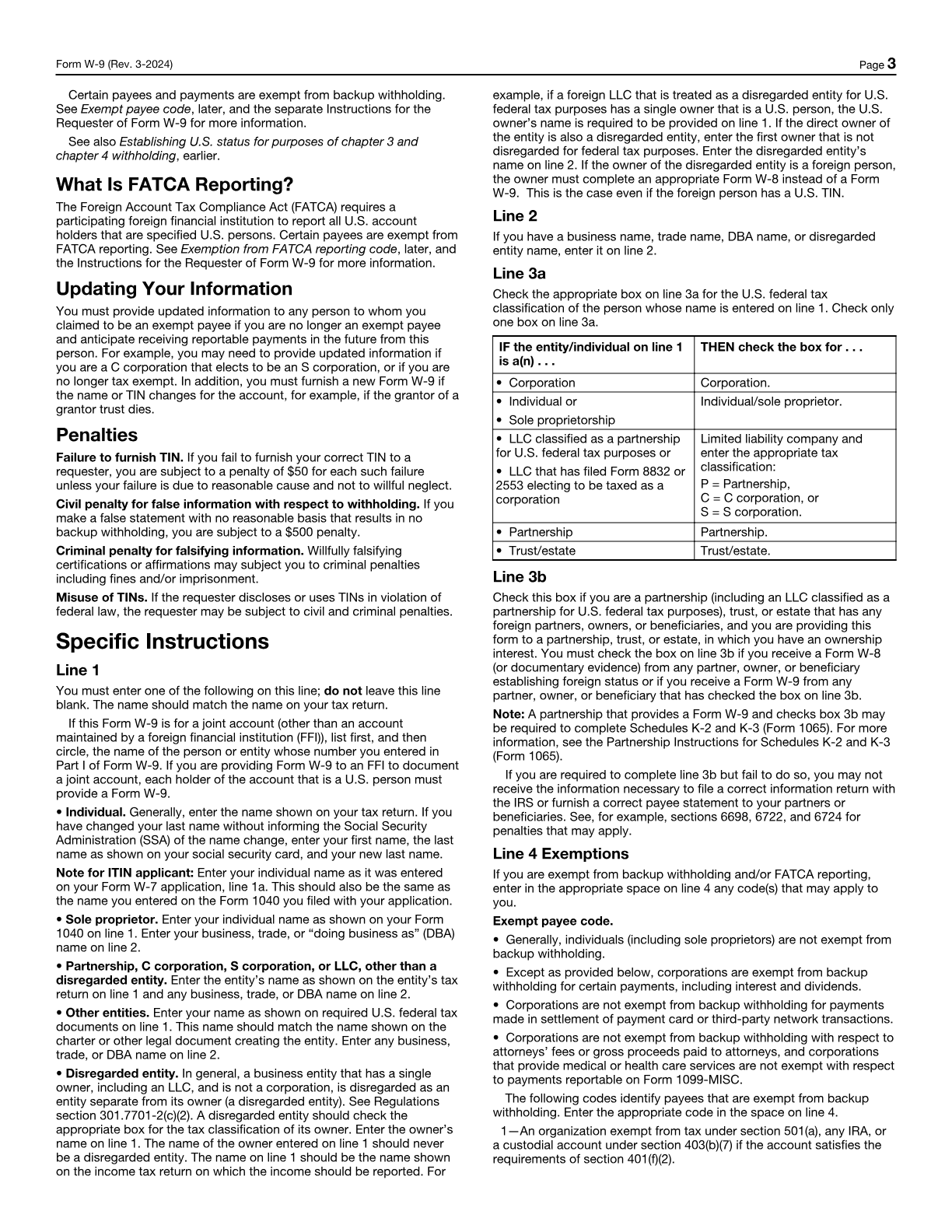
Page 3 of the same IRS PDF. The line 3a table in the right column maps an LLC classified as a partnership, or an LLC that has filed Form 8832 or 2553, to the LLC box with P, C or S. The line 3b instructions follow directly below.
Line 3b: leave it blank unless every condition is met
The March 2024 revision added line 3b. Its printed text joins three conditions with "and," so you check it only when all three apply:
- On line 3a you checked Partnership or Trust/estate, or checked LLC and entered P. An LLC that enters C or S never reaches this box.
- You are giving this W-9 to a partnership, trust, or estate in which you have an ownership interest.
- You have any foreign partners, owners, or beneficiaries.
The instructions on page 3 cover indirect ownership as well. You must check line 3b if a partner, owner or beneficiary gives you a Form W-8 (or documentary evidence) establishing foreign status, or gives you a W-9 with line 3b checked. The form's "What's New" section explains the purpose: a flow-through entity uses the box to report direct or indirect foreign partners, owners or beneficiaries when it gives a W-9 to another flow-through entity it holds an interest in.
In practice:
- A partnership-taxed LLC with a member living abroad sends a W-9 to a customer that buys its goods. The customer is not a partnership, trust or estate the LLC owns an interest in, so condition 2 fails. Leave 3b blank.
- The same LLC sends a W-9 to an investment partnership it owns an interest in. All three conditions can now apply, so check 3b if they do.
- Every member of your LLC is a U.S. person, but one member is a partnership that gave you a W-9 with 3b checked. When conditions 1 and 2 also apply, the instructions say you must check 3b.
Some quick online summaries reduce line 3b to "check it if you have foreign partners." That leaves out two of the three printed conditions. The stakes are real in both directions. A partnership that checks 3b may be required to complete Schedules K-2 and K-3 (Form 1065). If your LLC is required to complete line 3b and leaves it blank, the instructions warn that your LLC may not receive the information it needs to file a correct information return or furnish correct statements to its own partners or beneficiaries, and they point to penalty sections that may apply.
If your LLC elected corporate treatment
If a Form 8832 corporate election or a Form 2553 S corporation election is in effect for your LLC, the LLC is no longer disregarded, even if it has a single member. The current instructions define a disregarded entity as a single-owner business entity that is not a corporation. Complete the form as the entity:
- Line 1: the LLC's name as shown on its tax return. Use line 2 for a business, trade or DBA name.
- Line 3a: check LLC and enter C or S.
- Line 3b: does not apply, because it covers only Partnership, Trust/estate or LLC with P.
- Part I: the LLC's EIN. The IRS name-and-number chart lists "Corporation or LLC electing corporate status on Form 8832 or Form 2553" under the corporation's name and EIN.
- Line 4: corporate status can make an exempt payee code relevant for some payments. It does not cover everything. Corporations are not exempt from backup withholding for payment card or third-party network transactions or for attorneys' fees, and corporations providing medical or health care services are not exempt for payments reportable on Form 1099-MISC. S corporations must not enter an exempt payee code for broker transactions. Read the line 4 instructions before you enter any code.
Line 3a describes the LLC's current classification. An election that has been filed but has not yet taken effect is not your answer, so confirm the effective date in your IRS records.
If your LLC is a single-member LLC owned by an individual with no corporate election, this section does not apply. The owner's name goes on line 1, the LLC's name on line 2, Individual/sole proprietor on line 3a, and the owner's SSN (or the owner's EIN, if the owner has one) in Part I. A resident-alien owner who does not have, and is not eligible to get, an SSN enters an ITIN in the SSN space instead. In that case the person named on line 1 is the one who signs, when a signature is required. A separate Fylune guide to single-member LLC W-9s (your name or your business name) is planned; the essentials you need are covered above.
Lines 1-2 and Part I: a W-9 example for an LLC taxed as a partnership
Example Goods LLC is fictional. It is a domestic LLC with two U.S. individual members. It has never filed Form 8832 or Form 2553, so it keeps the default partnership classification. It has no separate trade name. A wholesale customer asks for a W-9 before paying its invoices for goods.
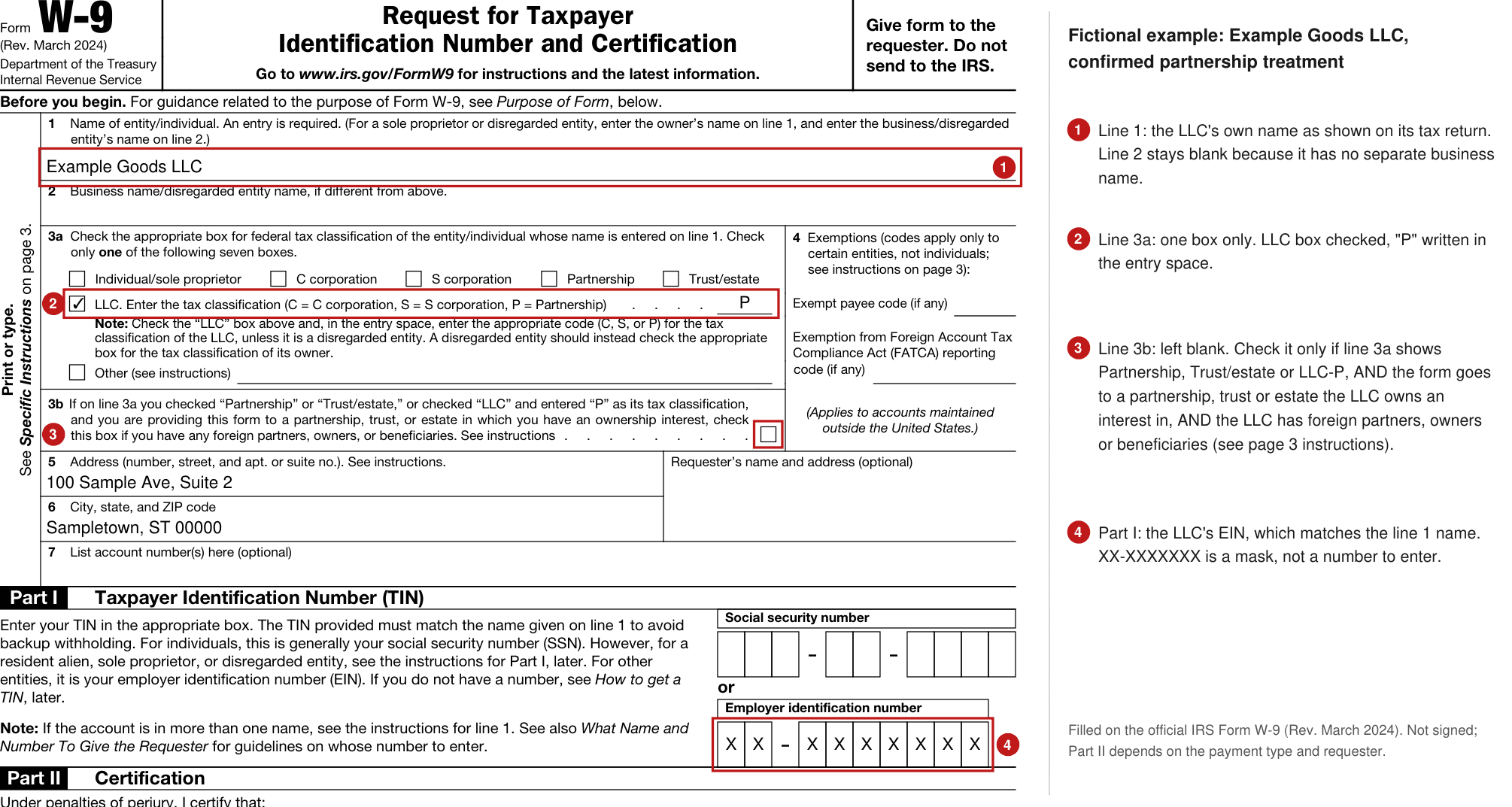
Fictional Example Goods LLC entered on a copy of the official Form W-9 (Rev. March 2024). The values, numbered markers and side notes were added for this article. The EIN is masked, and the form is unsigned.
| Field | Entry | Why |
|---|---|---|
| Line 1 | Example Goods LLC | A non-disregarded LLC enters its name as shown on its own tax return |
| Line 2 | Blank | Line 2 is for a business, trade, DBA or disregarded entity name, and this LLC has none |
| Line 3a | LLC box checked, P entered | An LLC classified as a partnership uses the LLC box with P |
| Line 3b | Blank | The customer is not a partnership, trust or estate the LLC owns an interest in |
| Line 4 | Blank | No exemption code has been confirmed |
| Lines 5-6 | 100 Sample Ave, Suite 2 / Sampletown, ST 00000 | The address where the requester will mail information returns |
| Line 7 | Blank | Optional |
| Part I | EIN: XX-XXXXXXX | An LLC classified as a partnership enters the entity's EIN |
| Part II | Depends on the payment type and the requester | See the certification section below |
The masked EIN is an illustration label. Never enter it, or any made-up number, on a real form.
Field review: do the name, box and TIN describe the same taxpayer?
Run this check on your own form before you send it:
| Check | Example Goods LLC | Result |
|---|---|---|
| Who is the line 1 taxpayer? | The LLC itself | Correct for a partnership-taxed LLC |
| Does line 3a describe that taxpayer? | LLC, P | Yes |
| Is only one line 3a box checked? | Only the LLC box | Yes |
| Does the Part I TIN belong to the line 1 name? | The LLC's EIN | Yes. The form says the TIN must match the line 1 name to avoid backup withholding |
| Are all three line 3b conditions met? | No | Leave 3b blank |
The mismatch to watch for is the LLC's name on line 1 with a member's SSN in Part I. For a partnership-taxed LLC, the EIN belongs with the LLC's name.
Review the applicable certification and signature instructions
Part II is a certification made under penalties of perjury. You certify that the TIN is correct, that you are not subject to backup withholding for one of the listed reasons, that you are a U.S. person, and that any FATCA code you entered is correct. You must cross out item 2 if the IRS has notified you that you are currently subject to backup withholding because you failed to report all interest and dividends on your tax return.
Whether a signature is required depends on the account or payment type. The Part II instructions on page 5 say:
- Other payments, which include payments made in the course of the requester's trade or business for rents, royalties and goods (other than bills for merchandise), as well as payments to a nonemployee for services: you must give your correct TIN, but you do not have to sign unless you have been notified that you previously gave an incorrect TIN.
- Interest, dividend, broker and barter exchange accounts opened after 1983, and broker accounts considered inactive during 1983: you must sign, or backup withholding will apply.
- Real estate transactions: you must sign.
- In every case, the withholding agent may ask you to sign even when the instructions would not require it, and many onboarding processes do.
Who signs: for a disregarded entity, the person named on line 1 must sign. For an LLC taxed as a partnership or corporation, the instructions do not name a specific title. Use someone authorized to make these certifications for the LLC, and check your operating agreement or ask your adviser if you are unsure.
Give the completed form to the requester. The form itself says not to send it to the IRS.
Fill and export your LLC's W-9 with Fylune
Once you have confirmed your classification, you can use the Fylune W-9 tool to fill the official March 2024 IRS W-9 and download the PDF. Manual filling and watermarked downloads are free. Watermark-free downloads require a purchase or Premium access.
An optional AI assistant asks separate follow-up questions about LLC ownership, line 3b and the SSN or EIN choice when they apply. You can skip any question and enter your TIN yourself. AI help uses account credits and sends your messages and current form fields to the AI provider. Web documents are saved to your cloud account and are not end-to-end encrypted.
Fylune does not decide your tax classification, does not sign or certify anything for you, and does not submit the form. The signature and date lines are not editable fields. You review the PDF, sign it if required, and give it to your requester.
FAQ
Does an LLC need to fill out a W-9?
A requester that must file an information return about payments to you uses the W-9 to get your correct TIN. Which taxpayer provides it depends on classification. A partnership-taxed or corporation-taxed LLC provides its own W-9 under its own name and EIN. For a disregarded LLC with a U.S. owner, the instructions say the owner, not the disregarded entity, provides the W-9 to establish non-foreign status. The owner's name and TIN go on line 1 and in Part I, and the LLC's name goes on line 2. For an individual owner, that TIN is usually an SSN (or the owner's EIN, if the owner has one); a resident-alien owner who does not have, and is not eligible to get, an SSN uses an ITIN. Only U.S. persons, including resident aliens, use Form W-9. If the owner of a disregarded LLC is a foreign person, the owner uses the appropriate Form W-8 instead.
Which address goes on lines 5 and 6?
Enter the address where you want to receive information returns. The instructions say this is where the requester will mail them. If it differs from the address the requester already has on file, enter "NEW" at the top. The old address may still be used until the requester updates its records.
What if an S corporation election takes effect later?
Complete line 3a with the classification currently in effect. After the election takes effect, the instructions require a new W-9 if the name or TIN on the account changes. That happens, for example, when a disregarded single-member LLC that reported its owner's name and SSN (or ITIN) starts reporting as the LLC under its own EIN. The instructions also require updated information if you claimed exempt payee status and no longer qualify, and they give a C corporation electing S corporation status as an example. If neither situation applies, ask the requester whether it wants an updated form.
Should my LLC check line 3b because one member lives abroad?
Only if all three printed conditions apply: line 3a shows Partnership, Trust/estate or LLC with P; you are giving the form to a partnership, trust or estate you own an interest in; and you have foreign partners, owners or beneficiaries, directly or through a member that reported them to you. A customer or bank does not meet the second condition unless it is a partnership, trust or estate in which the line 1 taxpayer has an ownership interest.
Have your classification confirmed? Fill your LLC's W-9 with Fylune, review the PDF, and give it to your requester.
Sources
- Form W-9 (Rev. March 2024), IRS: line 3a and 3b text, payee Specific Instructions, Part I TIN rules (including the resident-alien ITIN rule and Form W-7), the name-and-number chart and Part II signature requirements. Retrieved 2026-10-18.
- About Form W-9, IRS: form purpose and current revision. Retrieved 2026-10-18.
- Limited liability company (LLC), IRS: classification framework, domestic defaults and election effective dates. Retrieved 2026-10-18.
- Form W-9 (Rev. October 2018), IRS prior revision: the earlier line 3 label. Retrieved 2026-10-18.
This article gives general form-filling guidance and is not tax or legal advice. Example Goods LLC and all identifiers shown are fictional. Fylune is not affiliated with the IRS, does not determine tax classification, and does not submit forms to the IRS or to requesters.