

By Orion Wells
Start with the tax year and the applicable deadline. Then reconcile four amounts on Form 4868, the estimated total tax on line 4, payments counted on line 5, the balance on line 6, and the amount being paid on line 7. Check each figure against your records and the official field instructions. IRS Form 4868, pages 1-3
Edition check, November 17, 2026. The IRS current-revision link retrieved for this guide returns Form 4868 (2025). For most 2025 calendar-year taxpayers, its printed dates are April 15, 2026 for requesting the extension and October 15, 2026 for the extended return deadline. Both dates have passed. This guide uses that edition for a labeled field-reading example. Establish the rule and deadline that apply to your own case before preparing a request. IRS current revision · Form 4868, page 2
Check the tax year and deadline before using the worksheet

AI-generated editorial illustration showing the tax-year and review-date check.
Read the year printed on the form, the tax period being reviewed, and the instructions together. A downloadable form can remain available after its ordinary filing window closes. For this 2025 edition, fiscal-year taxpayers use the due date of their fiscal-year return. The instructions also describe rules for qualifying taxpayers outside the country and refer disaster-affected taxpayers to IRS relief information. Verify any exception against the actual circumstances and applicable IRS guidance. Form 4868, pages 1-2 · IRS disaster relief
If your proposed request would be untimely, stop the extension workflow and consult the IRS or an appropriate tax professional about the steps available for that return. The November review date in this article creates no additional filing period. Form 4868, “Qualifying for the Extension” and “When To File”
Choose how the extension will actually be requested
The official instructions describe three routes for a timely request, subject to the rules for the taxpayer concerned.
- Make a qualifying electronic payment of part or all of the estimated income tax and designate it for an extension. Follow the IRS payment instructions and retain the confirmation.
- E-file Form 4868 through tax software or a tax professional using IRS e-file. Retain the electronic acknowledgment.
- Complete and mail the paper form under the applicable instructions. Payment may accompany the paper request. The 2025 instructions require fiscal-year taxpayers to use the paper form.
The PDF can serve as a worksheet while you prepare for the chosen route. An extension concerns time to file the return. The payment due date still requires separate attention, and unpaid tax can accrue interest and penalties under the IRS rules. Form 4868, page 1 and “How To Make a Payment” on page 3
Map names, address and identifiers to Part I
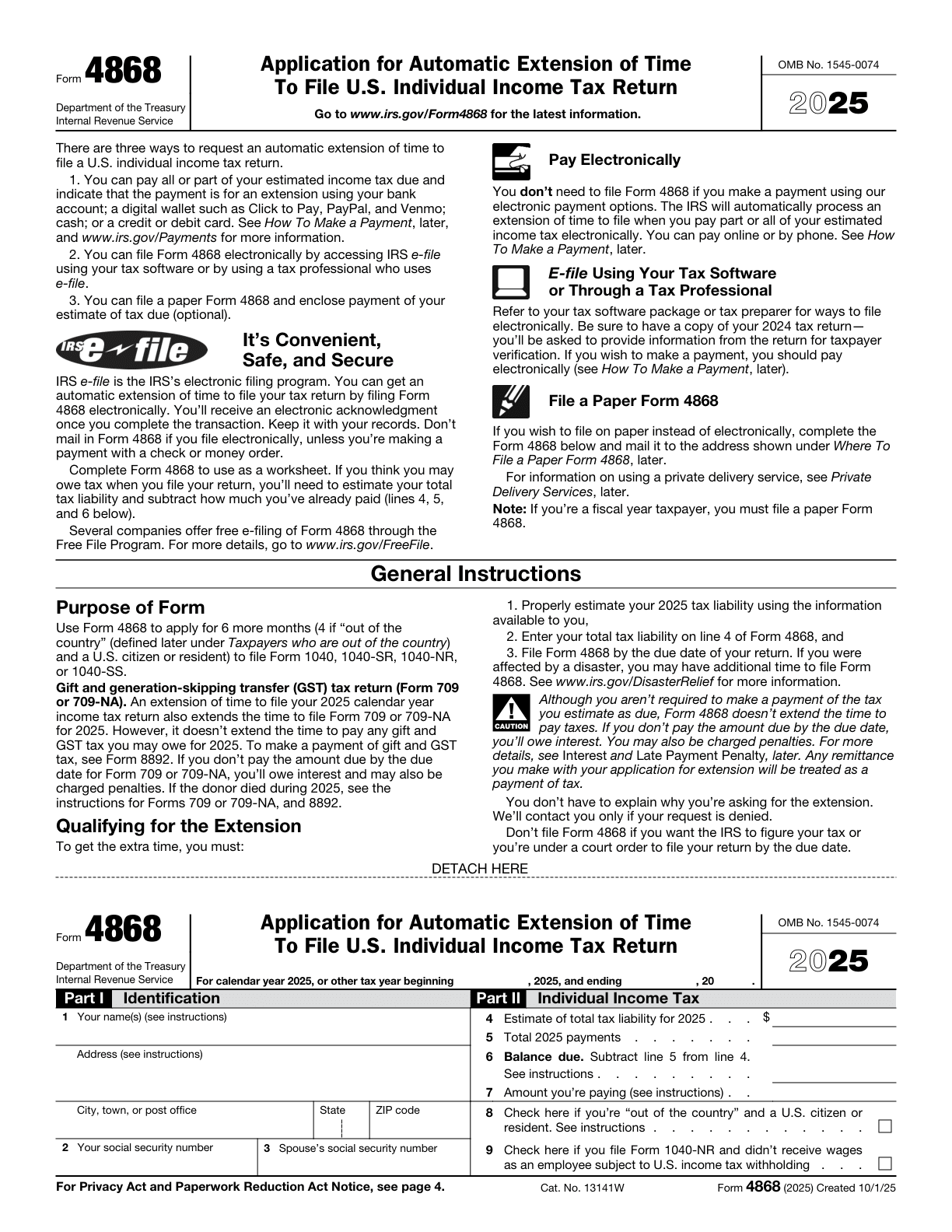
Official IRS Form 4868 (2025), page 1, retrieved November 17, 2026. The blank fields at the bottom are the fields discussed below. Open the full IRS PDF
Part I contains the name and address area on line 1, your Social Security number on line 2, and the spouse’s Social Security number on line 3. For a planned joint return, enter both names in the order they will appear on that return. Line 2 takes the SSN shown first on the joint return, and line 3 takes the other spouse’s SSN. Form 4868, page 1 and Part I instructions on page 3
The following EXAMPLE assumes a fictional individual, Casey Park, reviewing a domestic, calendar-year Form 1040 worksheet for an individual return. All sample identity entries are editorial placeholders.
| Part I location | EXAMPLE entry | Review against your own records |
|---|---|---|
| Line 1, name | EXAMPLE Casey Park | Name applicable to the return |
| Line 1, address | EXAMPLE SAMPLE ADDRESS | Actual correspondence address, including city, state and ZIP code |
| Line 2 | EXAMPLE XXX-XX-XXXX | Your applicable taxpayer identifier |
| Line 3 | Blank in this individual-return EXAMPLE | Spouse identifier when preparing a joint return |
Use your actual information in a real request. SAMPLE ADDRESS and the masked identifier cannot be submitted as completed answers. Part I also has special instructions for ITIN users and Form 1040-NR estate or trust filers. Read those instructions if your case differs from Casey’s example. If your mailing address changed after your last return, the instructions direct you to Form 8822 to update the IRS address record. Form 4868, Part I instructions, page 3
Reconcile lines 4 through 7 with a fictional ledger
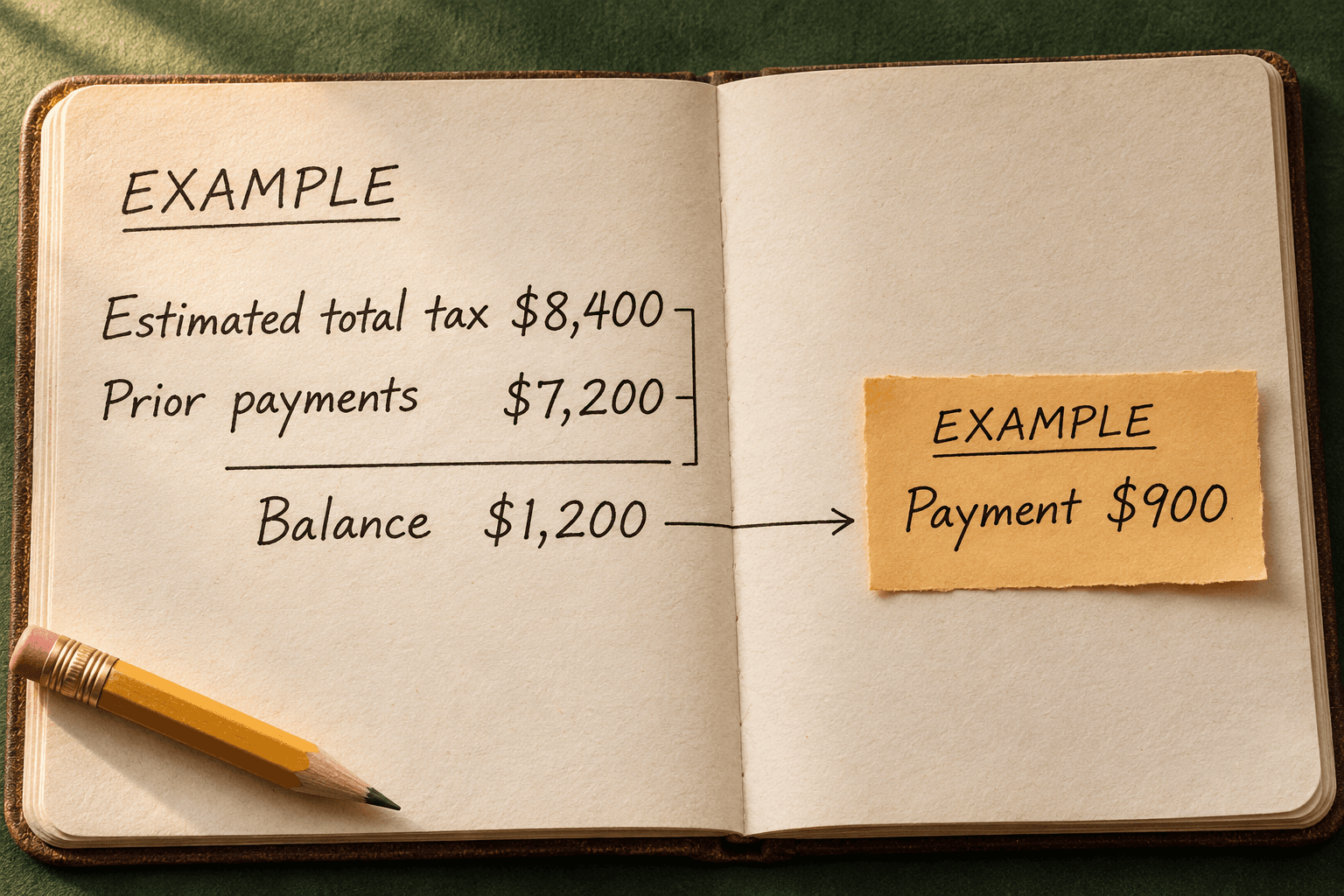
AI-generated editorial illustration of the fictional arithmetic and separate payment amount.
For this EXAMPLE, Casey’s fictional records show an estimated 2025 total tax liability of 7,200, and an illustrative payment of $900 with the request. Your estimate and payment records must support your own entries.
| Line | What the 2025 instructions ask you to establish | EXAMPLE amount | EXAMPLE source |
|---|---|---|---|
| 4 | Estimated total tax liability for the year | $8,400 | Fictional draft tax calculation |
| 5 | Total payments counted under the line 5 instructions | $7,200 | Fictional withholding and estimated-payment ledger |
| 6 | Line 4 minus line 5, with zero entered if line 5 exceeds line 4 | $1,200 | 7,200 |
| 7 | Amount being paid with the request | $900 | Fictional payment instruction |
For a 2025 Form 1040, 1040-SR or 1040-NR, the line 4 instructions point to the expected tax on return line 24. The line 5 instructions point to expected payments on return line 33, excluding Schedule 3, line 10. Keep the payment accompanying this Form 4868 out of line 5. Form 1040-SS has its own return-line references in the same instructions. Form 4868, lines 4-7 instructions, page 3
The subtraction produces EXAMPLE 900 on line 7 records the separate payment amount. After that illustrative payment, the arithmetic leaves **EXAMPLE 900 is sufficient or whether any relief applies. Form 4868, line 7 instructions and payment caution
When using the instructions for Form 4868, trace every number back to its evidence before entering it. Check for an extension payment counted twice or a full-year liability copied into the payment field.
For the preparation step, download the current official blank, then choose your PDF in Fylune’s editor. After entering your own figures, download and reopen the copy for review. Complete the actual extension request through the applicable IRS filing or payment channel. IRS blank and instructions · Open the Fylune editor
Handle conditional boxes using their full rules
Line 8 applies to a U.S. citizen or resident who meets the instructions’ definition of being out of the country on the return’s due date. The definition covers either living and having the main place of work outside the United States and Puerto Rico, or military or naval service on duty outside those places. The instructions also explain the treatment of a qualifying person physically present in the United States or Puerto Rico on that date. Read the complete rule when checking this box. Form 4868, pages 1-3
For the 2025 edition, line 9 concerns Form 1040-NR filers who received no wages as an employee subject to U.S. income tax withholding and whose return is due June 15, 2026. Verify both conditions in the specific instructions. Form 4868, line 9 instructions, page 3
Both boxes stay blank in Casey’s EXAMPLE. The fictional domestic Form 1040 scenario supplies neither special condition. For your own return, establish the applicable status from your facts and the official instructions.
Prepare and review the uploaded PDF
Use the upload workflow for this guide. The checked Fylune catalog has no built-in Form 4868 entry. The public editor offers Choose a File for a Markdown or PDF document, and states that files are automatically saved to your cloud account. Consider that Web storage behavior before choosing a file containing tax identifiers. Fylune editor
- Download the IRS blank for the applicable tax year and retain its instructions.
- Open Fylune’s editor, select Choose a File, and choose the downloaded PDF.
- Enter your own information using supported PDF fields or text annotations. Check placement, field boundaries and the year printed on the page. This guide uses manual review of the uploaded PDF.
- Download a copy and reopen it. Compare names, identifiers, checkbox states and lines 4-7 against your source records. Use the general PDF guide for the import and export review process.
Fylune supports PDF fields and text editing. Free PDF exports include a watermark, and clean exports have paid options. Inspect the actual export and current available options before choosing a copy for any agency process. For general import and export checks, see the PDF form guide. Fylune PDF editor · General PDF import and download review
The observed 2025 Form 4868 has no taxpayer-signature block. Follow the form’s actual layout and the requirements of the chosen filing route. Resolve any acceptance or output-format question with the IRS or an appropriate professional. Official Form 4868, page 1
Check the paper handoff for the actual filing context
First establish that the request can be made on time under the rule that applies to you. For a paper request, page 4’s routing table uses the taxpayer’s state or other location category and a separate column for whether a payment accompanies the form. Special filer categories have their own rows. Read that table in the applicable edition when choosing the destination. Form 4868, page 4
The instructions also distinguish designated private delivery services and their street addresses. For an IRS P.O. box destination, use the U.S. Postal Service as the instructions require. Keep proof appropriate to the actual filing or payment route, including the electronic acknowledgment or payment confirmation where applicable. Saving a reviewed worksheet completes the editing step. Filing and payment each require their own agency-channel action. Form 4868, pages 1, 3 and 4
Final example and review checklist
Casey’s EXAMPLE ends with line 4 at 7,200, line 6 at 900. The EXAMPLE identity entries remain Casey Park, SAMPLE ADDRESS and a masked SSN. Use those placeholders only for learning the layout.
Before moving from preparation to an actual request, check each item against your own records and the applicable IRS instructions.
- Confirm the form’s tax-year label and your actual deadline. Stop an untimely extension request and establish the appropriate next step.
- Support line 4 with a reasonable estimate of the full-year tax liability.
- Reconcile line 5 to the payments counted by its instructions, keeping the payment with this extension request separate.
- Verify line 6 by subtraction. Use zero when line 5 exceeds line 4.
- Match line 7 to the actual amount you intend to pay with the request.
- Verify every condition that controls lines 8 and 9.
- Replace all EXAMPLE identity placeholders with your own applicable information in a real request.
- Reopen the exported PDF and inspect entries, checkbox states, placement, the tax year and any watermark.
- Follow the observed form layout and the signature requirements of the actual route.
- Complete the applicable IRS filing and payment actions, then retain their confirmations.
Use the current IRS instructions to resolve the substantive tax questions. Obtain professional help where your tax-year, eligibility, deadline or payment circumstances need assessment. IRS Form 4868 and instructions
Sources
- IRS Form 4868 current-revision page, checked November 17, 2026.
- IRS Form 4868 (2025) and its four-page instructions, retrieved November 17, 2026. Page 1 contains the form and filing routes, page 2 contains timing rules, page 3 contains field and payment instructions, and page 4 contains paper destinations.
- Fylune editor and PDF editor feature page, checked November 17, 2026, for the device-file entry and editing workflow.
- Fylune general PDF form guide, linked for import and export review. Product behavior in this guide follows the current editor and product policy.