

By Nina@Aurcue, Chief Marketing Officer at Aurcue
A useful REG 343 example follows one set of facts across both pages: the person who owns the car goes in Section 2, a confirmed lender goes in Section 3, and each date answers its own question. Before signing, compare the entries with the records that supplied them, including the vehicle identifiers repeated at the top of page 2.
This walkthrough uses the California DMV's REG 343, revision 12/2022. The official application instructs you to complete both sides. The case below is fictional and deliberately leaves some facts unresolved. It shows how to review an application, not how to establish eligibility or satisfy every registration requirement. Read the official REG 343 and its printed instructions.
Define the fictional application
Alex Morgan is preparing the application on October 24, 2026, after moving to California with a personally owned 2018 Toyota Corolla, a gasoline passenger car previously titled and registered in another state. Alex bought it used from a dealer on May 15, 2024. Ownership is not changing, there is no co-owner or lease, and the car is not used to transport passengers for hire.
For this teaching case, Alex's records establish these facts:
- A loan remains outstanding. The title identifies a lender, called Example Auto Finance here. That name is fictional and must never be copied into a real application.
- The car arrived in California on a transport truck on October 20, 2026. Alex first drove it in California on October 22.
- Alex became a California resident on October 19 and began work there on October 23. Alex has not yet obtained a California driver license.
- On October 24, the odometer showed 62,418.7 miles, and Alex knows of no odometer discrepancy.
- The acquisition record supports a vehicle price of $18,500 after applying the form's cost inclusions and exclusions. The car has had no body-type modifications since purchase and is not a revived junk or salvage vehicle.
The VIN, driver license number, exact addresses, lender's ELT details and intended disposition of the old plates are not supplied in this example. Alex still needs those records. An empty field does not mean “None.”
Build the source-fact worksheet first
If you are working out how to fill out REG 343, start with a worksheet separate from the application. Put unresolved questions there while you gather the records. Do not submit the example's placeholders or treat its unanswered questions as permission to omit required information.
| Record or supplied fact | Where it belongs | Review question for Alex |
|---|---|---|
| Title, registration and the vehicle's identifying information | Section 1; repeat VIN, make and year model above Section 5 | Do both pages identify the same car? Resolve any mismatch before copying it. |
| Alex Morgan, the sole registered owner | Section 2 | Does the full name match the ownership record? In this fictional case, Morgan is the last name and Alex is the first name. |
| Current physical address, county and any different mailing address | Section 2 | What are the exact street, unit, city, state and ZIP? The case supplies no street address. |
| Confirmed lender and its required address/ELT information | Section 3 | What does the title show, and what exact ELT listing applies? |
| 62,418.7 miles observed October 24 | Section 4 | Is the unit Miles, and have the tenths been omitted? |
| Transport receipt and first California use | Section 5 | Are October 20 entry and October 22 first operation kept separate? |
| Residency and employment facts | Section 5 | Which of work, California licensing or residency happened first? |
| May 15, 2024 purchase record; used car bought outside California | Section 5 | Do the acquisition date and the Used/Outside CA selections agree? |
| $18,500 qualifying purchase price; dealer sale | Section 6 | Does the amount follow the form's cost instructions, and is only Purchase selected? |
| Acquisition-to-entry interval and plate records | Section 7 | Does the tax question's one-year condition apply, and what will happen to the plates? |
| Alex's and any spouse's military-service facts | Section 8 | Have both current-service and last-licensing questions been answered from actual facts? |
The section references above follow the official two-page application. Keep the source records beside the form so you can trace each correction to a fact.
Review the first side: vehicle, owner and lienholder
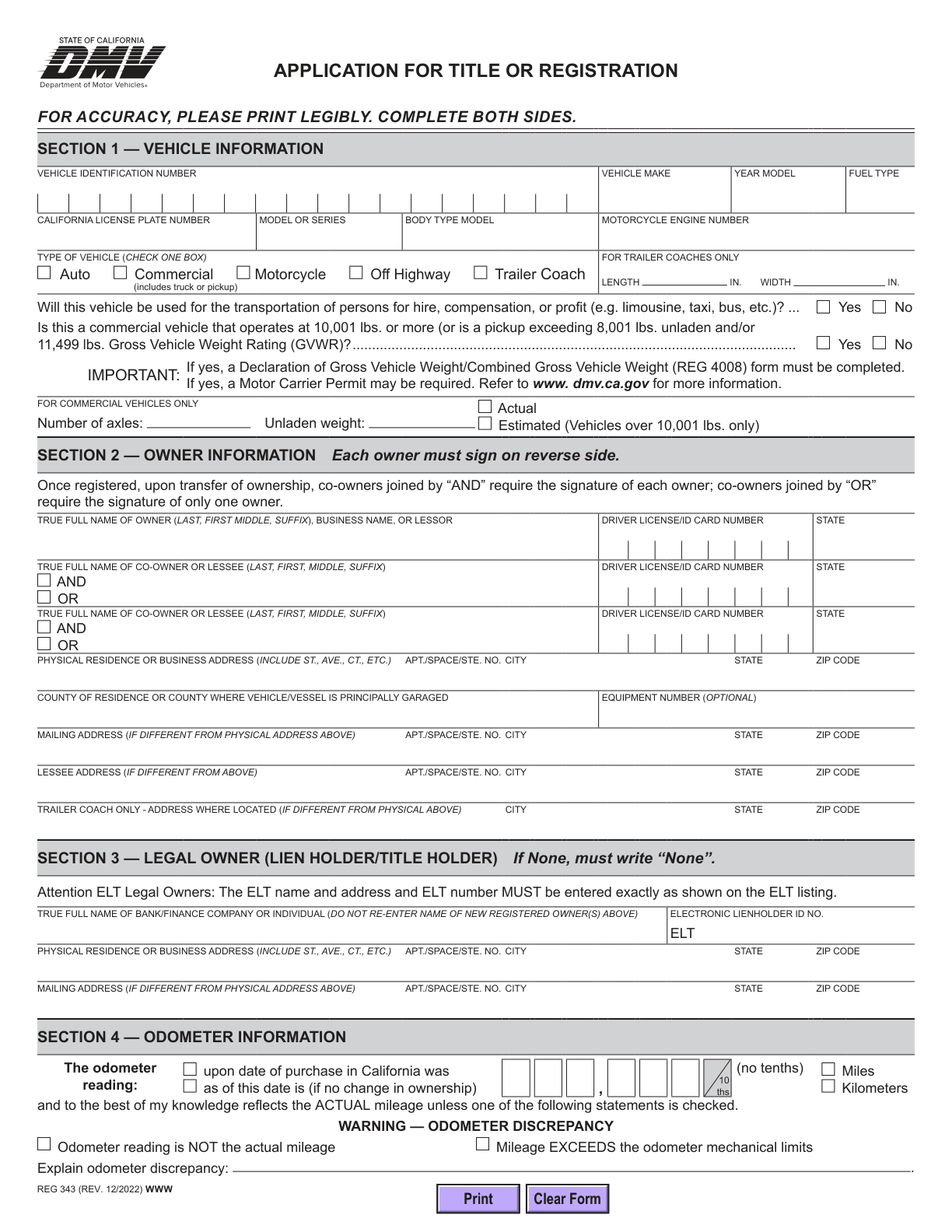
Official blank page 1, reproduced without fictional entries or altered field labels. Use it to locate the sections in the worksheet. Open the full-size official PDF.
Section 1: identify this car
For Alex's stated passenger-car use, the vehicle type is Auto. The make is Toyota, the year model is 2018 and the model or series is Corolla. Copy the VIN from verified vehicle/title records; do not create a sample VIN. Confirm the body-type entry from the relevant records or DMV guidance instead of guessing a code.
The form separately asks about transportation for hire and commercial-vehicle weight. Alex's stated personal passenger-car use answers the hire question No and does not make this a commercial vehicle. Motorcycle, trailer-coach and commercial-only entries do not describe this case. A truck or pickup needs its own review; do not extend this example's answers to one. REG 343, Section 1.
Section 2: name the owner, not the lender
Alex belongs in the owner section. Copy the full name, the required license/ID information, physical address and county from the appropriate records. Use the separate mailing-address area when the mailing address differs. Alex must supply the missing address and ID details before completing the application.
DMV's nonresident instructions address owners who have not been issued a California DL/ID: enter the out-of-state number and identify its state of issuance as instructed. Do not invent a California number because Alex has moved. DMV basic registration requirements.
There is no co-owner in this case, so it does not illustrate an AND/OR choice. If your title has multiple owners, resolve that choice for your own situation. The form's explanation of later transfers does not cancel its instruction that each owner sign this application. REG 343, Section 2.
Section 3: confirm the legal owner or lienholder
The heading is “LEGAL OWNER (LIEN HOLDER/TITLE HOLDER).” Alex's confirmed lender belongs here, with its correct details. This section expressly says not to repeat the new registered owner's name. For an ELT legal owner, the name, address and ELT number must match the ELT listing exactly.
Write “None” only when you have confirmed there is no legal owner/lienholder to enter. An unknown lender address, a missing statement or a loan you believe has been paid off is a reason to check the records, not a reason to assume no lien. REG 343, Section 3.
Keep the odometer and dates distinct
Section 4: preserve the unit, omit the tenths
Because ownership is not changing, Alex uses the current-reading option marked “as of this date is (if no change in ownership).” The fictional reading is 62,418 whole miles. The form provides a unit choice and instructs you to omit tenths; it also provides separate discrepancy statements. Do not describe a reading as actual mileage if the facts do not support that certification. REG 343, Section 4.
| What the odometer actually displays | Whole-number reading | Unit selection |
|---|---|---|
| Alex's fictional 62,418.7 miles | 62418 | Miles |
| A separate fictional vehicle showing 62,418.7 kilometers | 62418 | Kilometers |
The second row is a unit comparison, not a conversion of Alex's mileage. The same digits with a different unit describe a different distance. Do not round up the tenths or select Miles for a kilometer reading.
Section 5: answer four different date questions
| Date question on the form | Alex's fictional entry | Why |
|---|---|---|
| Date vehicle entered or will enter California | 10/20/2026 | The transport record establishes entry. |
| Date vehicle first operated in California | 10/22/2026 | Delivery on a transporter and Alex's first drive are different events in this case. |
| Date you went to work in California, obtained a CA driver license, or became a resident | 10/19/2026 | The form asks for whichever occurred first. Residency precedes work, and no CA license has been issued. |
| Date vehicle was purchased or acquired | 05/15/2024 | Moving does not change the original acquisition date. The associated choices are Used and Outside CA. |
Do not reuse October 20 in every box because it looks like a convenient “move date.” For a vehicle previously registered in California and now returning, the form asks for its most recent California entry. It also has a box for someone who did not own the vehicle at entry. Those facts are not part of Alex's case. If the vehicle has not yet operated in California, the form permits the intended operation date. For the work/license/residency question, it provides separate instructions for residents since birth and a nonresident checkbox. REG 343, Section 5.
Review the reverse side and conditional questions
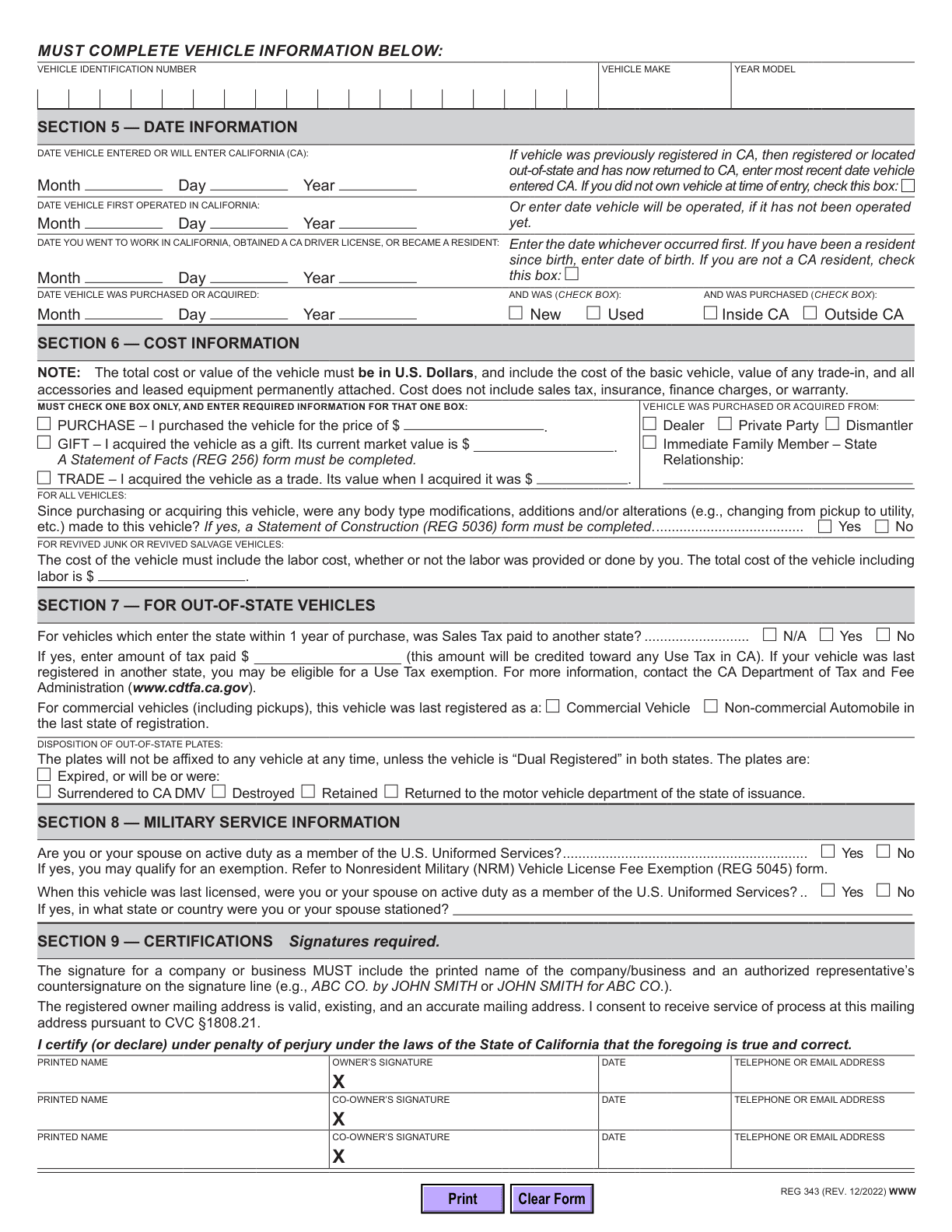
Official blank page 2. The vehicle-information strip above Section 5 is separate from the identifiers on page 1. Open the full-size official PDF.
Start page 2 by repeating the VIN, make and year model in the spaces above Section 5. A complete first page does not fill those spaces for you.
In Section 6, Alex selects Purchase, enters the supported $18,500 price and identifies the seller category as Dealer. The form requires one cost category, not a combination of Purchase, Gift and Trade. Its cost definition includes the basic vehicle, any trade-in value, and permanently attached accessories and leased equipment. It excludes sales tax, insurance, finance charges and warranty. Do not substitute the remaining loan balance or today's resale estimate for the purchase figure.
A gift is outside this case. If that is your actual transaction, the form asks for current market value and requires a Statement of Facts (REG 256). That branch does not establish a tax exemption by itself. Alex's confirmed lack of body-type changes supports No to the modifications question. The revived-junk/salvage cost line does not apply to the stated case. REG 343, page 2, Section 6.
Section 7's sales-tax question is scoped to vehicles entering California within one year of purchase. Alex purchased in May 2024 and entered in October 2026, so that question's N/A choice fits the fictional dates. This is not a finding that Alex owes no California tax. For a case within the one-year window, answer from the purchase and tax records, and enter the documented tax amount if the answer is Yes. Resolve any exemption question with the authority identified in the form.
The old plates need a separate answer. The form offers dispositions including surrender, destruction, retention and return to the issuing state, alongside an expired-plates option. Alex has not supplied that fact, so the worksheet must retain a question: What will happen to the out-of-state plates under the applicable DMV process? Do not choose Retained merely because the plates are still on the car. The form also restricts their future use unless the vehicle is dual registered. Its commercial-registration question is conditional and does not describe this passenger car. REG 343, Section 7.
Section 8 asks about active duty now and when the vehicle was last licensed, including a spouse's service. Those facts were not supplied. Keep both as open questions rather than filling No by default. A Yes answer directs the applicant to additional military information; it does not automatically award an exemption. REG 343, Section 8.
Compare a mistaken example with a reviewed one
These are three deliberate errors in the fictional case, not entries from a real applicant.
| Mistaken entry | Reviewed correction | Record or check that resolves it |
|---|---|---|
| Example Auto Finance is entered as the owner in Section 2, while Alex appears in Section 3. | Put Alex in the owner section and the confirmed lender in the legal-owner section. Replace the fictional lender label with the real lender's required details. | Ownership record and lender/ELT information, checked against Sections 2 and 3. |
| An early worksheet guesses October 20 for first California operation because it knows only the arrival date. | Keep the date unresolved until Alex confirms the first operation. For this completed fictional fact set, that date is October 22. | Alex's confirmed use history, separately from the transport receipt. |
| The VIN appears on page 1, but the vehicle-information strip on page 2 is blank. | Copy the verified VIN to page 2 and check the repeated make and year model as well. | Compare both pages with the same vehicle/title records, character by character. |
Use the same review on your own application: identify the record behind each answer, then check every place that fact appears. The official REG 343 instructions and field labels provide the places to check.
Complete the owner review and next step
Conceptual illustration of the fictional case. These are personal notes, not a completed REG 343 or a Fylune screen; the review item is still unchecked.
Before signing, resolve the missing identifiers, addresses, lender details, plate disposition and military answers. The two-page example is not ready to submit while those facts remain open.
Then inspect the actual downloaded PDF, rather than relying only on the editor view:
- Both pages are present, legible and free of cut-off entries.
- VIN, make and year model agree on both sides and with the source records.
- Owner and lender have not been swapped; no fictional name or placeholder remains.
- The odometer unit, whole-number reading and any discrepancy statement are correct.
- Each date answers its own question, and the selected cost category agrees with the acquisition record.
- Every applicable conditional question has a supported answer.
- Each owner reviews the certification and supplies the required signature, printed name, date and contact detail in Section 9.
The form directs each owner to sign the reverse side. Section 9 includes an address certification and a declaration under penalty of perjury. Do not sign an unresolved draft. REG 343, Sections 2 and 9.
REG 343 is one part of the transaction. Consult DMV's nonresident registration requirements for the ownership and registration documents, vehicle verification, applicable smog requirements and fees. This example does not calculate a tax bill, determine eligibility or replace DMV's transaction instructions.
Prepare and review your own copy in Fylune
Open the REG 343 template, enter your own facts, and review the PDF before you download or print. Fylune is a document editor for web and desktop. On supported forms, AI can help place the facts you supply; you remain responsible for checking them. You may add your own supported visible signature, but AI does not sign, certify your identity or submit the application. The receiving agency determines its accepted process, and Fylune does not register the vehicle or guarantee acceptance.
Web edits save automatically in account-owned, server-readable cloud snapshots, including guest accounts. Desktop files remain local, with encrypted sync available by explicit opt-in. Core editing is free; free PDF exports include a watermark, and clean exports have paid options. Fylune product and storage information.
Sources
- California DMV: REG 343, Application for Title or Registration, revision 12/2022. Both pages, including the instructions printed beside the fields.
- California DMV: 12.005 Basic Registration Requirements. Nonresident transaction requirements and owner DL/ID guidance.
- California DMV: Statement of Facts, REG 256. The additional form named in REG 343's gift branch.
- Fylune's REG 343 template and product information. Template availability and editor capabilities and limits.